Jaladarsha Collective initiated a session on Women’s Rights and Muslim Personal Law conducted by Sabir Ahmed at Swarupdah Gram Panchayat on 1st February 2021. We discovered a village composed largely, if not almost entirely, of economically backward women who had been married off around 12-14 years, and then, divorced or widowed, mostly after they bore children. Mostly farm labourers, they wished to move out of the village to work elsewhere, especially as caregivers, which many of them did before the lockdown. Formally educated mostly till class 10, with class 5 or lower being the norm, they very much wish their children to get properly educated and find jobs outside, a difficult task due to them losing interest and dropping out, or struggling with tuition fees from private tutors, the government school education being below standard.
On our way back, to our friend’s house where we were accommodated, we passed a mechanized stitching shop, where we learnt, men stitch shirts and blouses at ₹13 a piece. The yard that greeted us was already preoccupied by ducks, fowl, and goats. Rearing these animals to a healthy adulthood, having them give birth to young, and selling them at higher prices constitutes an important source of the family incomes. The room given to us, a concrete house in construction, belonged to our friend’s uncle. This is a common trend in the village currently, of new, concrete houses being constructed, as part of Pradhan Mantri Vikash Yojana, the trend possibly having increased more post the destruction of Amphan. Ours incidentally retained its earthen base and floors, while also sporting modern LED lamps, like many other similar buildings in the village. As part of this exercise and to strengthen the fields, we found mud being excavated in the village and carried elsewhere in tractors as well.
We passed several such sites on our way to the banks of River Sonai, which also serves as the border between India & Bangladesh. This part of the border is said to be relatively peaceful, with gunfire often being exchanged in other parts, downstream and up. The banks boasted of a BSF outpost and few boats, only one being in use though. This was a spot where villagers freely bathed in and did so even in that hour of twilight. However, a mistaken sight and a comment from the young woman who guided us, made us realize how strong the supernatural and superstitious played in their lives — expecting demons, ghosts and other kinds, as naturally as one may observe birds.
The ghats also bore several mango trees. However, unlike those on the residential grounds, whose berries (কুল) neighbours could munch on (as were we), these trees were owned by the soldiers, who rented out the buds, earning from the fruits thus. There were boys playing cricket underneath. On our way back, we found another group of children, much within the village, much younger and without any gender separation, playing a game similar to tag. We also witnessed one woman feeding clams and snails to her geese, that she’ collected from the pond earlier in the day. This was incidentally her maternal place, where she’d also come to use the see-saw for husking and grinding. A peculiar site one could see around the village, was that of kebab style dried cow dung, which the villagers used as fuel for cooking.
On returning, we found ourselves greeted with evening tea and snacks, along with full rolls of biscuits, which would consistently come with every such meal. This we found quite strange, wondering if it was just the goodness of heart, confusion regarding consumption, or maybe just some blind hope of an urban boon. The sun having bade its daily farewell, the sky revealed to us a new delight — clear visibility of the stars and constellations, which would give any astronomer a turn on. A sight which the cold weather made us blind to, with a bonfire from the dry wood of the post-harvest leftovers. A little further, we found the woman we met earlier, now at her in-laws place, cooking for the night. She however, was using collected sticks and other wood, like what we used for the bonfires. We learnt later that those cow dung kebabs are only for those who owned cows, not those without. This wasn’t the only time that I felt property raised its ugly head. Her kitchen lacked a roof and wall, sitting next to her in-laws’, which was not only walled and roofed with a tall chimney, but also used the said cow dung kebabs and had extra stoves.
One thing that particularly amazed me was how well adapted the people were to this hard life, so far from our urban comfort, and so low on energy demand, as to manage with one light, no fridge, cook using collected wood, and bathe in the shivering cold of the night in cold water.
At night, a misinformed rumour came by us, about the power supply being switched off for the coming two days, due to a transformer installation in nearby Dakbunglow. We learnt that in case of such events or even minor repairs, the electricity supply stays off for consistent periods of time in the village, even 20 days at a stretch. Recently such events have reduced, but previously, this was coupled with the power being switched off for about an hour every night daily, illegally, to smuggle goods in the dark. Thus, the electric supply to the village is quite unstable, calling for localized renewable sources. Thankfully, this did not occur during our stay.
During this first day and night, we couldn’t help but compare it with our urban lives. The only toilet for 3-4 houses here was limited to one with only hand-pumped deep tube wells to provide the water. Needless to mention that this was outside the house and eerily, without any lights affixed, needing people to carry their own ones. The village in fact, really lacked lights for illuminating the exterior spaces. This I’d say is a precursor to any activity that’d require people to meet after sunset, the part of the day currently free from the socio-economic pressures of the village. Strangely, the toilet was quite clean despite the pressure put upon it. The arrangement was mostly similar throughout the village.
The following morning we went out to survey women, with the help of the vaccination supervisor for the village, who we’d incidentally met, feeding the ducks and cooking at night. We interviewed several women, who mostly owned no land, worked as farm labourers, and reared cattle. They’d little education or particular skill-sets, beyond cooking and domestic activities. Mostly married around 12-14, they’re today struggling to educate their children, with only NGO & government schemes or kits aiding them. Failing, most have chosen to marry their daughters off at minor ages — just to escape poverty.
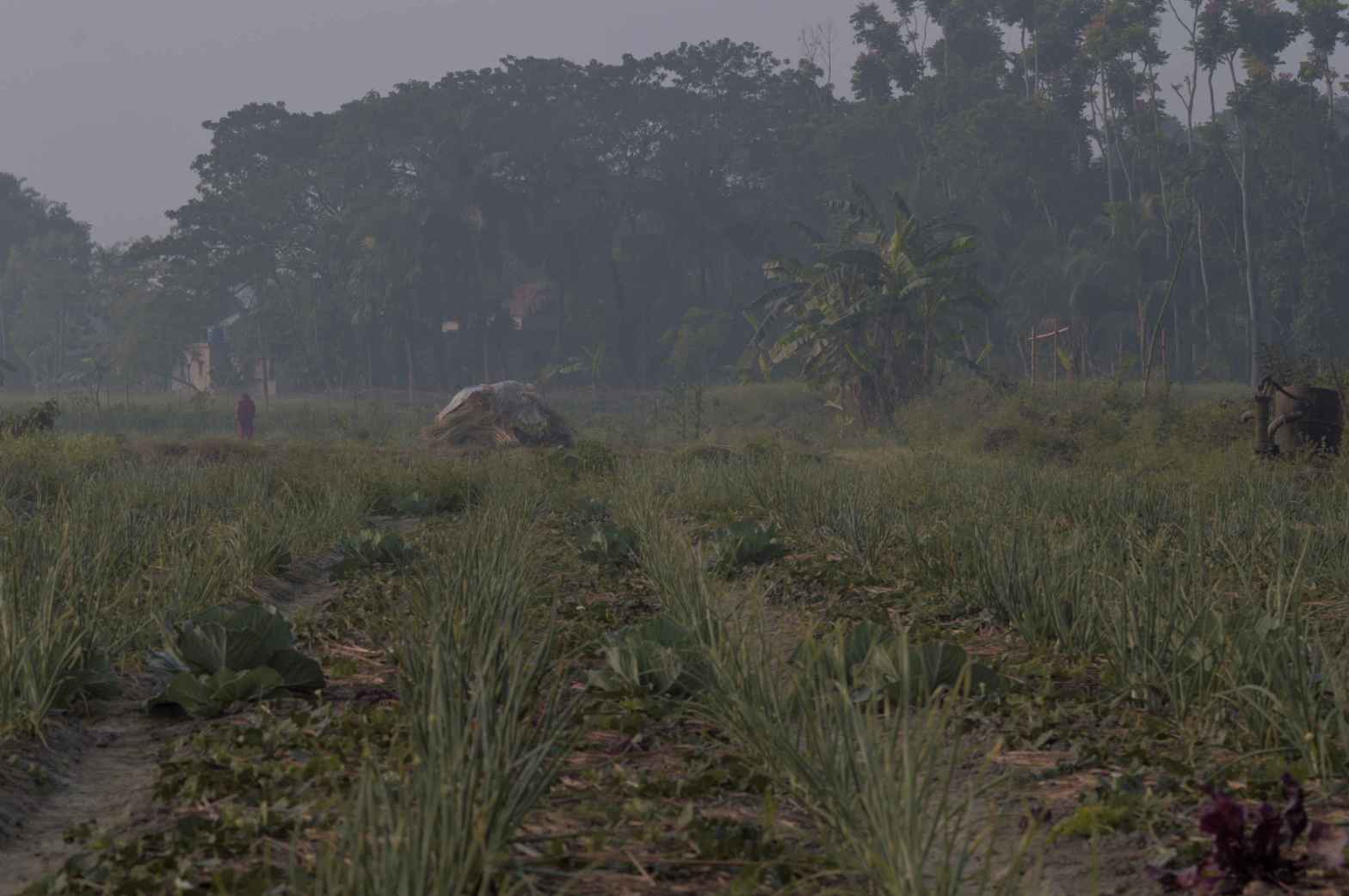
Most women and men in the village do not own land, but are forced to take it on lease or on loan. This is a particularly important reason for not developing any regenerative attitude, the land being someone else’s in the future. The lease price is generally ₹10,000 for 8 katahs. Following our interviews, we travelled to the border check post, to check the crops there. We found significantly greener pastures, with intercropping practised — little gourd (পটল) being the primary crop, mixed with onions, cabbages, cauliflower and corn on the periphery. There were also mustard and rice fields, and few date palms, all being tapped for jaggery. The palms were too few, but we learnt that farmers find it difficult to plat tress due to neighbouring farmers complaining against their shades. In this area, irrigated by not-at-all-salty river water, the farming method is extremely mechanized and petrochemical industry intensive. A farmer we interviewed too agreed, and said they’re bound to the practice despite its nutritional drawbacks, due to higher yields compared to traditional mono-cropping with organic manures. He even agreed to have applied insecticides against earthworms which ruined the little gourds, which he knew was insane. This was sad and shocking, and we realized that strong examples of modern, permaculture approaches have to be spread to remove such misconceptions.
It must be mentioned here that the purity of the river water is in strong contrast to the salinity of the groundwater here. Factoring in groundwater recharge issues, one wonders if rainwater harvesting or solar desalination, for which enough heat could be obtained during the day, could be some alternatives, if the river water is not obtainable for domestic use due to legal reasons. One fascinating thing was that the slightly warmer water evaporating visibly in the cold weather and there being a distinct but mild H₂S smell coming out. It is uncertain, if this is due to bacterial action or some deep-seated geothermal source.
Time soon found us in a follow-up session with the women, where more tragic stories of domestic violence and abuse cropped up — from the ‘usual’ getting divorced after childbirth, to having kerosene poured into one’s eyes in anger. In organizing this event, there was some noted confusion and lack of coordination, which could be attributed to the circumstances. When asked about future plans and desires, however, we found a general wish of leaving as care workers abroad. Further discussions about working from the village, created a choice between manufacturing food items to stitching. Most strangely desired to stitch, despite even the most enthusiastic people admittedly lacking necessary skills. One woman, who earlier used to work in Mumbai at ₹14,000 a month, showed a strong proficiency and knowledge in making food products, especially pickles, whose recipes she picked up elsewhere and could teach others. We got a literal taste of her skills the next morning through some delicious bread rolls, too. I still wonder why the others consistently chose stitching, despite discussing sweet recipes — due to the desire to revive some old sewing machines at home they had or maybe due to some influence of the garment workshop in the village. But of course, this would need some thought, as the village lacked lights, which would be a necessity for the task, the women being free mostly after twilight. Whatever the decision though, the women do require strong training to help grow these dreams, be it in food packaging and laws or even stitching. I believe if they could come together one hour every week, as they had for our meet, a lot of possibilities would emerge, such sessions serving greatly to sharing their existing skills alongside learning new ones.
A thing to mention, we found in our walks earlier, some curious new products from other parts of India and our state, uncommon in Kolkata; “phuchka chips”, being one particular, which some of them too got intrigued by.
Concluding the day with a visit to the nearest bus stand, we realized how far villagers had to travel for even the most basic stationery items, it being a long auto rickshaw ride away. This part was quite urban and even hosted a fair, which for a friend of ours was a first time experience. It goes to say a lot regarding the lack of freedom in the lives of women, whether due to work loads or outright control. Interactions with some grown men the next day would give us a taste of the same through a barrage of casual questions about personal choices and breaking norms, with many associating certain casual deeds like sleeping on a tree to the male sex alone.
During the evening, we found a second instance of property politics, when we had to be shifted from our friend’s uncle’s house to her brother’s despite him not being an inhabitant for long. This moment also brought up our friend’s fear of ghosts at night, which if one generalizes to the village, makes movement difficult beyond dusk.
The date-palm sap for breakfast next morning was extremely refreshing a taste, to say the least. It is however, not transportable and quite difficult to obtain due to its lack of abundance. The morning sight of cattle made us realize the life women had.
Life in Daharkanda begins early in the morning, to call the roosters rather than to their call. So too begins the list women’s responsibilities. Set free the ducks, chickens and goats, but not too much, lest they stroll into the fields, off the yards. Prepare the feed, some specially, others, using leftovers of the day gone by. Duty call! Jobs like vaccination rounds or into the fields as labourers for the farms. Prepare the food, with wood or dung kebabs for their earthen stoves. The children need looking after, the husbands toiling in fields or them being divorced or widowed, single mothers — bathing, clothing and making them food. Looking after their education, official and via tuition. Serve lunch, eat, do the dishes, create more feed.
Thus, the day passes, with few fleeting moments to spare for a meet or anything else.
As the sun begins to set, time knocks to herd the cattle back into their cages. Scatter some feed, call them back, out loud. The next day’s preparation begins now. On the see-saw husking and grinding, or maybe into the pond, collecting clams and snails. Finally, it’s time to warm up dinner. As night falls, one has to return home, since that’s the rule. Time to do the dishes one last time. Off to sleep now, for the day to repeat the day gone by.
The cattle, a central part of their lives, with most preferring small ones like goats and fowl to cows, it is strange that no food processing work has emerged in the village, such as goat milk cheese or egg related items like pastry cream or mayonnaise, mustard being so strongly present as a crop in the village. Our visit to the adjacent fields that morning and to nearby houses in the afternoon, gave us a glimpse of the same, from harvesting to threshing. Even the leftover crops, usually burned, does seem quite usable as a unique decoration item for urban homes.
The fields, themselves, that were left after the harvest, had signs of unintentional mulching. Nevertheless, the fate of most of it would be to in the jaws of tractors, upturned and mixed with fertilizers, despite there being signs of nitrogen fixing plants in the lifeless heaths. This takes quite a long wait too, as lacking roads, they can’t be brought in through other fields, until all has been harvested, everywhere. The paddy fields boasted of algae, probably from eutrophication or probably intentional. It did, sadly, lack fish whose wastes are documented to have improved the process. The fields also had several coconut trees, whose fruits were plucked ripe and exported. Coconut oil making too is a dying art it seems. So too is possibly clay making, there being many sun dried mud stoves with chimneys in the making, but all dependent on mud from the river banks.
On the final evening, we decided to have a picnic, when the women would be free. This exercise was quite interesting and insightful. As all had to be bought from the market, the budget came to ₹50 per head. This, however, was not an easy feat like one would imagine and there was a lot of observable negotiations happening to achieve this. Following this collection, however, the shopping was done by the women, quite smoothly. At night everyone coordinated well and started with the cooking, sharing equipment, both their daily equipment and hacked agricultural equipment for illumination. The tasks for cooking did however, seem to fall on few shoulders. Sadly, as time swept on, into the night, the picnic got limited to only the warm-up song and recital sessions. Most dispersed with the food, saying it was too late, and they’d not be allowed by their families to stay longer.
The next day, after a few final visits and tours, and tasting a delicacy from the previous night’s labour, we bade farewell.
Penned by Arkoprovo Ghosh.
 Jaladarsha