Radhika Bhargava
Sinthilya village is located near the India-Bangladesh border towards the north of Sundarbans mangrove forests’ core areas. It is a village that replicates and lives with every love problem of the Sundarbans – tiger attacks, erosion, flooding, single crop lands, saltwater intrusion and cyclone damage. Evidently the area is poverty ridden and the population is dealing with numerous issues to survive.
However, with the combined efforts of the locals and Jaladarsh collective some significant solutions are being implemented. One such solution is of mangrove restoration. The purpose of the restoration project undertaken by the Jaladarsh collective is not only to promote green spaces but to also restore the shoreline and provide alternative livelihood options. It is an invest for the sustainable future of the village. The eastern area of Sithalia has multiple mangrove restoration beds. Some of these are undertaken by the local government who is taking care of naturally accreting and naturally restored lands, and Jaladarsh is contributing by converting other eroding wastelands into mangrove beds.
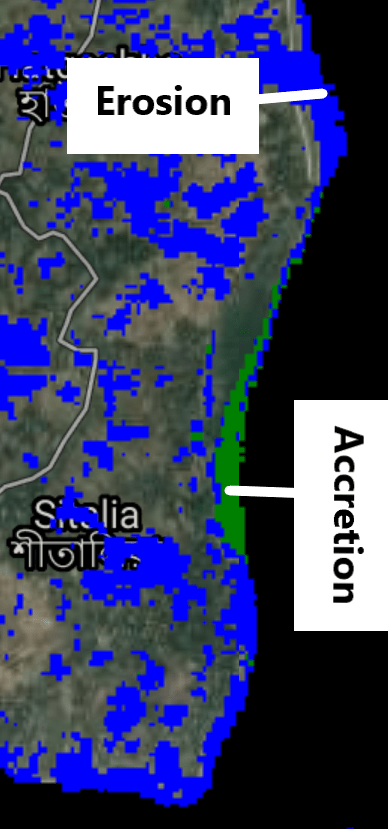
Erosion is one of the most prevalent issues in the region and it exacerbates the impacts of other stressors in the region. One of the direct impacts of erosion is loss of land which leads to migration of people and loss of biodiversity. Eroding lands also act as a foreground for extreme losses that can abruptly take place overnight. In the Indian Sundarbans, the total amount of erosion has been 136 km2 over the past 35 years. In Sinthilya, erosion is taking place on the eastern side (Fig 1.)
A question that often arises with mangrove plantation, one that we discussed with the local community on Jaladarsha Collective’s field trip to Sinthilya in March was – is it better to plant mangroves on accreting land or on eroding land?
While planting mangroves on an accreting land is promising as the land will keep growing and the newly planted mangroves will help in holding on to the soil, the downside is that the land or that area is preferred for land growth so mangroves might naturally settle and grow there. So, it might make sense to promote mangrove growth in the eroding areas. Eroding land is prone to further erosion, if there are no mangroves growing in that area, it might get eroded very quickly. If mangroves are grown in such areas, they will hold on to whatever land is remaining and with other intervention erosion can be prevented. If a land start eroding once, it will keep eroding unless the force is disturbed or distributed. With mangrove plantations and some bamboo, brick, and wired structures such disturbance and distribution of force can be achieved.
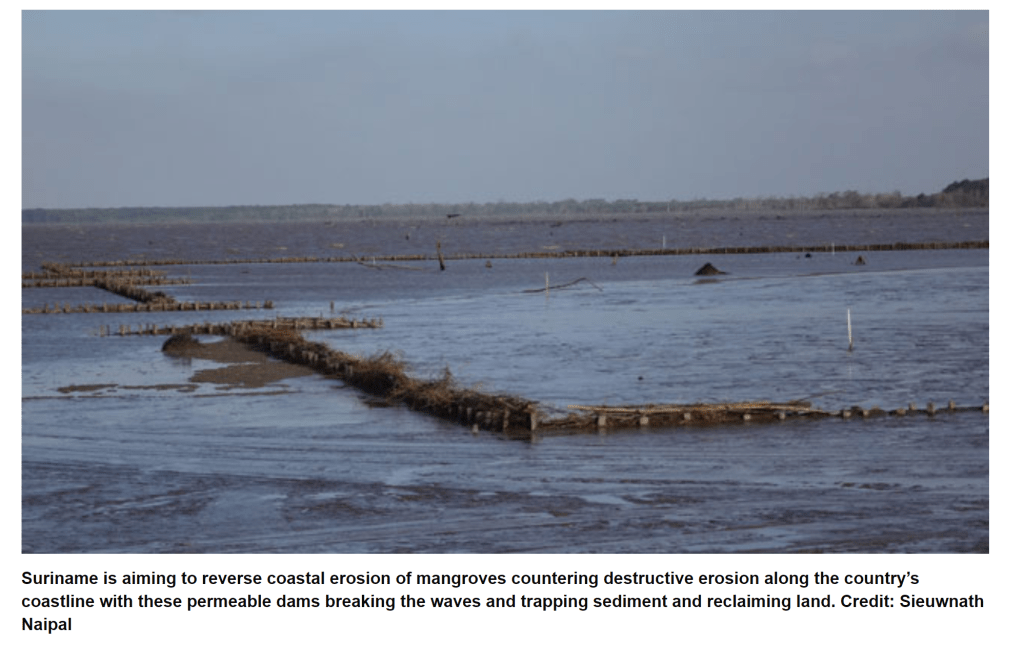
The beds where Jaladarsha Collective has planted mangroves is on the eroding beds. The plantations have successfully survived for _ months. It is promising that the plantations would develop into healthy mangrove beds. But a sign of worry is the eroding shape of the shoreline. When the shoreline is curved like a ‘c’ shape, the impact waves that hit the surface is increased which causes additional erosion. The collective can investigate nature based solutions1 (like permeable dams made of wood, bamboo, brush) to somewhat weaken the waves that hit the shoreline. With a caveat that they are properly monitored for the long term and any side effects are remedied. Therefore, with reduced wave energy and increased support from successfully growing mangroves the stability of a historically eroding bed can be promoted.
Another key lesson from the plantation initiatives of the collective is promoting the growth of mangrove predecessor species like dhani grass (Aeluropus lagopoids) and Sea Holly (Acanthus sp.). These species were growing along with mangroves on their planted beds. These species aid in bed formation that will eventually promote mangrove habitation. Along with these species, various crustaceans (shrimp, crabs) and other mangrove associated flora and fauna are also needed to create a healthy environment to promote mangrove health on plantation beds.
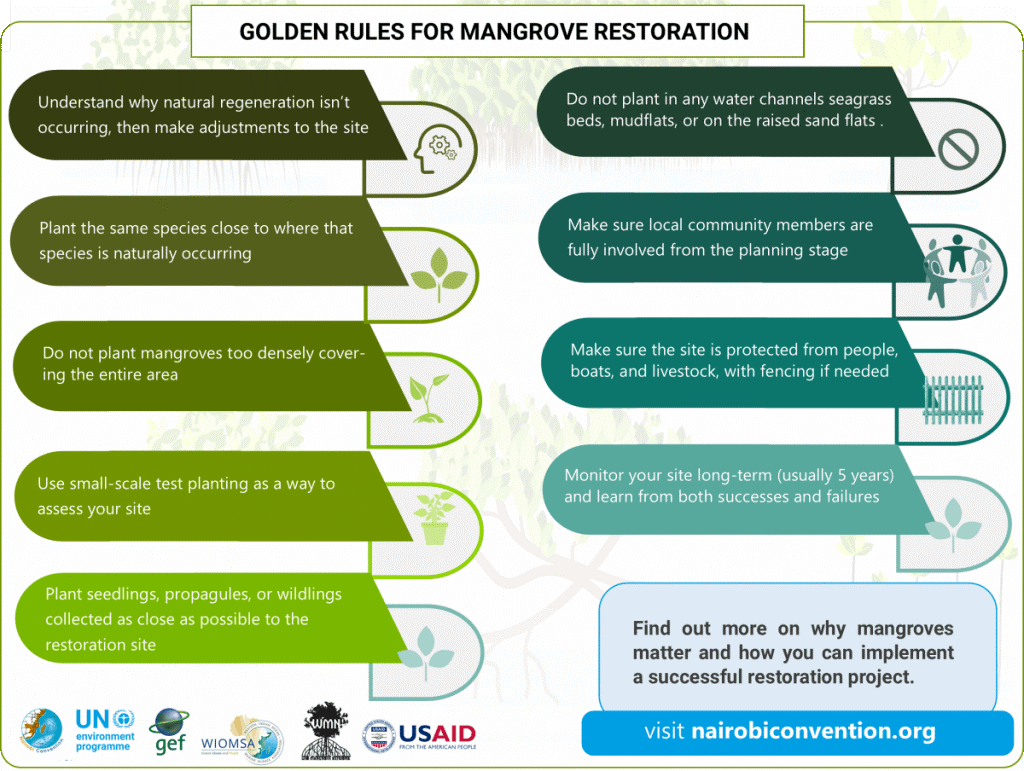
One problem that is yet to be resolved is the issue of goats eating and disturbing newly planted mangrove beds. The goats in the Sundarbans have developed affinity for salty and muddy mangroves! So, during summer when there is not as many green spaces around, they prefer to munch on mangroves. In some areas fencing can be done but sometimes the goats won’t even spare the bamboo fencing. Villagers try to be vigilant of goats, but it is not the most proactive solution. One way would be to give feed to the goats so that they don’t have to go to mangroves or may be psychological training can help as a long-term solution. Finally, some of the basic things every mangrove plantation initiative should consider before, during and after plantation is done are outlined in the infographic below.
References:
- https://doi.org/10.1016/j.ecss.2020.106798
- https://www.conservation.org/blog/new-science-restoring-forests-coastal-protection-and-more?utm_campaign=General&utm_medium=social&utm_source=twitter&s_src=twitter&s_subsrc=General_2021Jul26
About the Author:
Radhika Bhargava is a coastal scientist who specializes in large-scale ecosystem processes and threats. She uses geospatial analysis and social sciences to understand how transboundary ecosystems can be co-managed with the community. Currently she is working on the transboundary governance of the Sundarbans for her PhD thesis at the National University of Singapore in the Mangrove Lab and as a National Geographic Explorer.
 Jaladarsha