Ankita Bose
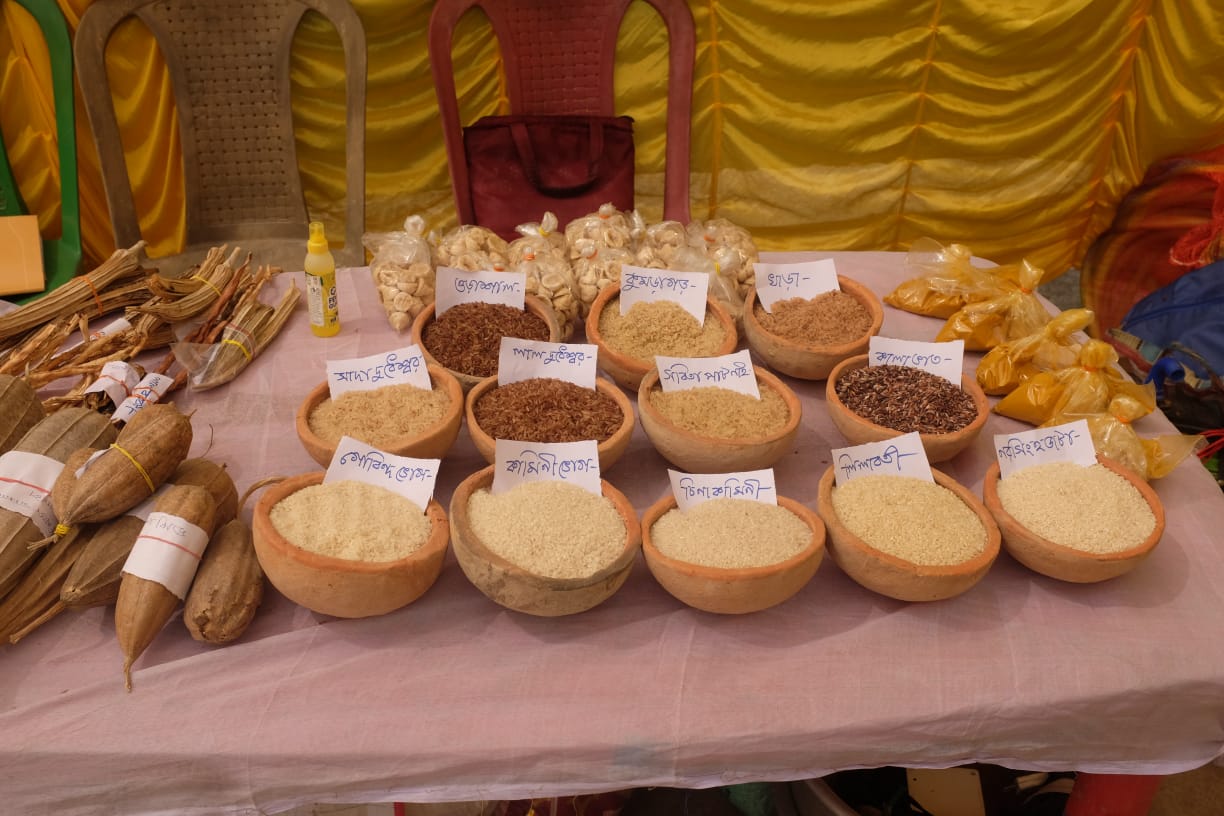
The mild chill descended on the morning of 16th February, 2024, when I, along with a few members of the Jaladarsha Collective, started out for the ‘Roots and Rights: Indigenous Seed Festival’, to be held at Gobindokathi & Patghora Netaji Maidan at Jogeshganj in Hingalganj block of Sunderbans in the North 24 Parganas district of West Bengal. I had volunteered to help out with the festival upon the request of my beloved friend, Aopala Banerjee, who works relentlessly for the conservation and revival of all things belonging to nature, community living, and bound by the invisible threads of love.
Being a student and ardent lover of literature, colours of romanticism seep through my veins. When I see blue, I am not reminded of royalty, instead my mind wanders to the myriad shades of blue that adorn the horizon; my mind travels to how the blue mixes with the green and the grey, to form the mirror-like surface of water bodies. With the heart of a romantic, and the zeal of a social activist, I ventured into the blue and the green of the Sunderbans with the purpose of aiding the local farmers’ struggle—one of the most relevant and significant struggle in contemporary India, given that a lot of farmers from the northern states of the country including Uttar Pradesh, Rajasthan, Gujarat, Haryana, have yet again collectively revived their dissent against the neo-liberal capitalistic farming practices that serves the ones in power, disregarding the interests of the ones who put in the labour and feed the people of the nation.
The scenes encountered during the boat ride from Dhamakhali Ghat to Jogeshganj Ghat displayed the cracks behind the romantic beauty of nature. The ghats were broken and dilapidated, making it a risky affair for people boarding the boats. The erosion of the river plains was apparent; however, the resilience of the local communities was also visible as most shores had cemented embankments surrounded with bamboo structures to prevent the river plains from eroding further. Few mangrove trees skirted some shores, although the numbers had declined from the last time that I had travelled to the Sunderbans, sometime in 2015.
Once we reached the hotel at Jogeshganj in the afternoon, we were quite tired, but all the team members were enthused with the spirit of the upcoming seed festival and quickly shed off their exhaustion to plunge into the pool of work that needed completion before the commencement of the festival. The remaining part of the afternoon and evening was spent in making posters and planning extensively for the exciting events of the next day.
The morning of February 17th brought with it the anticipation of meeting farmers from our land and exchanging knowledge across boundaries of caste, class, gender, and other imposed identities. Personally, I was excited about the coming together of human beings and sharing the know-hows of their realities and building a language that traverses the margins of our existence. For me, that is what constitutes literature—an amalgamation of thoughts beyond the various spaces and times that intersect to form our realities. The event was to be held from 11am to 4pm, a five-hour long celebration of the struggles of farmers in our land, the underrepresentation of women in the farming sector despite them having the most amount of contribution, and how art and literature are intricately woven into these narratives of labour and struggle.
As soon as the clock struck 10.30 am, farmers from different regions of the state started pouring in with their store of preserved seeds cultivated naturally without the use of chemical fertilizers and pesticides. I was surprised at how punctual these farmers were. While working in different sectors in the city, I have often encountered people taking time for granted; most are insensitive to others’ time, but here, in the village of Jogeshganj, the farmers understood the value of time and their passion was exhibited through the adherence of the schedule charted out for them.
The proceedings of the day began with the lighting of the auspicious lamp, an intrinsic part of rituals for any festival held in our country land. Thereafter, the co-founder of Jaladarsha Collective, Sayantoni Datta gave her introductory speech about flood-resistant environment-friendly seeds that have lost its relevance in the post-modern world. The most notable part of her impassioned speech, something that touched my heart, was when she shared her experience of travelling to the Sunderbans after the Amphan cyclone in 2020. She highlighted how the farmers gathered around where relief kits and aid was being given, and demanded flood resilient seeds instead, which would help them in the long-term.
Subsequently, a performance titled ‘Seed Energy’ by Madhyama Halder, a prolific dancer. In her performance, Madhyama exhibited the journey of a seed as it grows into a plant, with movements that portrayed how a seed nurtures itself, absorbs the nutrients from the soil, and then proudly springs up its head above the soil. She also highlighted the importance of preserving naturally farmed seeds, sharing knowledge about them, and the significance of community living among the farmers and rural people of the land through various movements and abhinaya. Her performance was highly emotive and resonated with the local people. It was followed by a group of local women singing Tushu gaan that portrayed the daily grinds of cultivating paddy, lentils, and vegetables in the lands owned by them or their family members.
Afterwards, two panel discussions were conducted that united academicians, researchers, and more significantly, the local women farmers who had grassroots knowledge about issues of agricultural practices, animal husbandry, and the benefits of natural farming. The first panel discussion that was held on the specificities of women’s role in agriculture recognised the mammoth participation of women farmers who are involved with agricultural labour. Chandra Mukhopadhyay, a researcher and archivist, who was a part of the panel, shared her experiences of intermingling with the farmers of Bengal, and collating the folk songs that speak of their toil and labour. Further, the other panelists shared their experiences of farming. The most significant factor that came up during the discussion was that of how women contributed to 80 percent of the labour required for farming, yet they are neglected and not given enough recognition in the national statistics and their representation is scarce, especially with regards to owning land and decision-making roles.
The second panel discussion was held on climate-resilient farming practices wherein a plethora of people came together to discuss how agricultural produce could be increased with indigenous methods. In such a context, I would like to highlight my personal experience. I was stationed at the desk registering and documenting the farmers’ demands, along with another woman farmer assisting me. I indulged in an extensive conversation with my co-worker and learned a lot about the local problems in the region. She informed me about a particular variety of paddy known as Radhakathi that can survive floods and the high salt content of the water typical to the region. In tandem with her narrative, the second panel discussion highlighted the importance of seeds cultivated through natural processes, ignoring the lure of commercially cultivated crops. Most of the panelists emphasized that locally and naturally farmed seeds are more climate resilient, salt tolerant, and flood resistant than the High Yielding Variety (HYV) seeds promoted by the corporate machineries. The farmers particularly stressed upon how naturally farmed seeds are the only seeds that can grow to a height of 4-7 feet while the other HYV seeds are unable to meet such standards of cultivation, especially when it comes to floods which are common to the area. Additionally, women’s participation in agriculture was celebrated and prominence was given to how they must be given their due respect in terms of land ownership and decision-making.
The events for the day also comprised kids coming together to exhibit performances encouraging communal harmony, and various farmers sharing their knowledge and experiences of cultivating seeds produced through natural means.
Two small discussions were held on the nitty-gritties of goat rearing and fish farming that witnessed the enthusiastic participation of the audience. In accordance with the local demands of the people, these concentrated discussions on animal husbandry provided the local people with the know-hows of goat rearing and fish cultivation, both of which are important and profitable means of livelihood for the people of Sunderbans.
Finally, the best was saved for the last. A group of local women farmers came together to present a performance that juxtaposed dance, songs, and theatre in tandem with the movement of the Theatre of the Oppressed started by Brazilian theatre practitioner, Augusto Boal, in the 1970s. Beginning with a tribal kathi dance, indigenous to the tribal community of the region, they later delved into matters of prime importance. The message of their performance was loud and clear: they narrativized the entire episode of the Green Revolution in the 1960s and how thereafter, the farmers were lured into using HYV seeds that instead of increasing their production and cutting down their costs, did exactly the opposite. The neo-liberal practices increased their costs as the farmers now had to buy chemical fertilizers and pesticides to keep their produce from rotting. Eventually, the greed for social mobility resulted in the farmers incurring huge losses and some of them resorting to commit suicide in order to escape debts. The performance resounded with one and all in the audience and brought waves of empathy and left many rolling in tears .
At the desk designated for collecting farmers’ demands and complaints, many came up sharing their anecdotes of how there isn’t enough mechanism to drain out excess water during floods, which is why a lot of their crops are damaged. They said that despite reiterating their demands for a proper drainage system, the government has done little to fulfil their demands.
All in all, this experience of volunteering at the seed festival nourished the seed of my soul, the one that had laid dormant and thirsty for tangible social change. When I saw the farmers devotedly propelling natural farming practices, something told me that all’s not lost to the greed of power and money. On my way back, the soothing boat ride that embraced my being with the blanket of fog, reminded me of lines that I had read written by a social activist from a land as far as Uruguay. Eduardo Galeano had written in his book Open Veins of Latin America, “It’s worthwhile to die for things without which it’s not worthwhile to live.” Indeed, it is. The farmers from my own land showed me that the path for social change intersects the values of hope, struggle, and resilience. When the boat lost its way in the foggy shadows of the morning, all fear evaded us. We were content that we had contributed to the struggle of life and death that the farmers of our land continually engage in, day in and day out, only to feed the billions in our country. For them, fighting for their life’s sustenance dissolves all fear of death, and that was the spirit upheld by the seed festival.
Ankita Bose is a writer, translator, poet, and dreamer. She holds a MA in Comparative Literature from Jadavpur University and a BA in Sociology from Presidency University
 Jaladarsha