by Joshua Bodhinetra
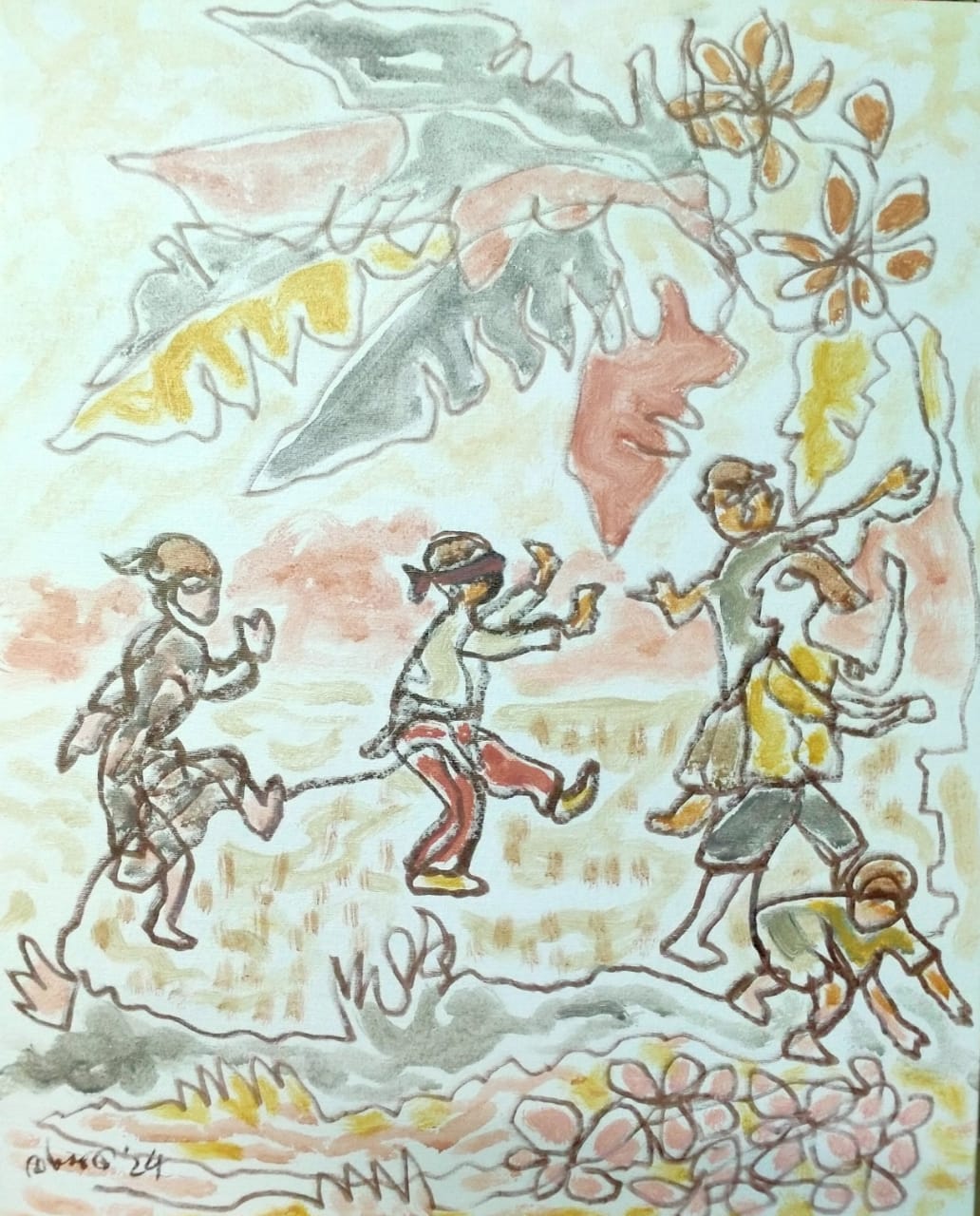
In Pic: Khelaghor, Embracing Play by Koustabh Chakrabarty, Ecotone Exhibits
Sabbe sattā, sabbe pāņā, sabbe bhūtā,
Sabbe puggalā, sabbe attabhāvapariyāpannā,
Sabbā itthiyo, sabbe purisā,
Sukhitā hantu…sukhitā hantu…sukhitā hantu…
(May all creatures, all life, all beings,
May all persons, all individuals,
May all women, all men,
Be happy…be happy…be happy…)
What happens when the liminal gets filled with the metaphysical? Does nature reclaim spacetime from humans, or do we subsume nature under our mechanised paradigm? Curiously, Koustabh Chakrabarty’s ECOTONE doesn’t ask these questions at all, rather he straightaway dives into the answer. Progressing from the playful to the tumultuous, from machines to mother-earth, this exhibition is guaranteed to leave everyone spellbound.
His brushstrokes challenge our linear understanding of co-existence, his palette outright rejects our unidimensional idea of ecosystems. He pledges neither a superficial harmony, nor some contrived nihilism. Koustabh, ergo our beloved Kosha-da employs multiple artistic genre to capture the exact moment when nature within collides with nature without. Through frolicking children, storm-lashed mangroves, sweat-soaked brick-kilns, poisoned mines and quantum entanglement of our collective anātman, he repeatedly creates a dissonant dream-lyricism seldom seen in contemporary art.
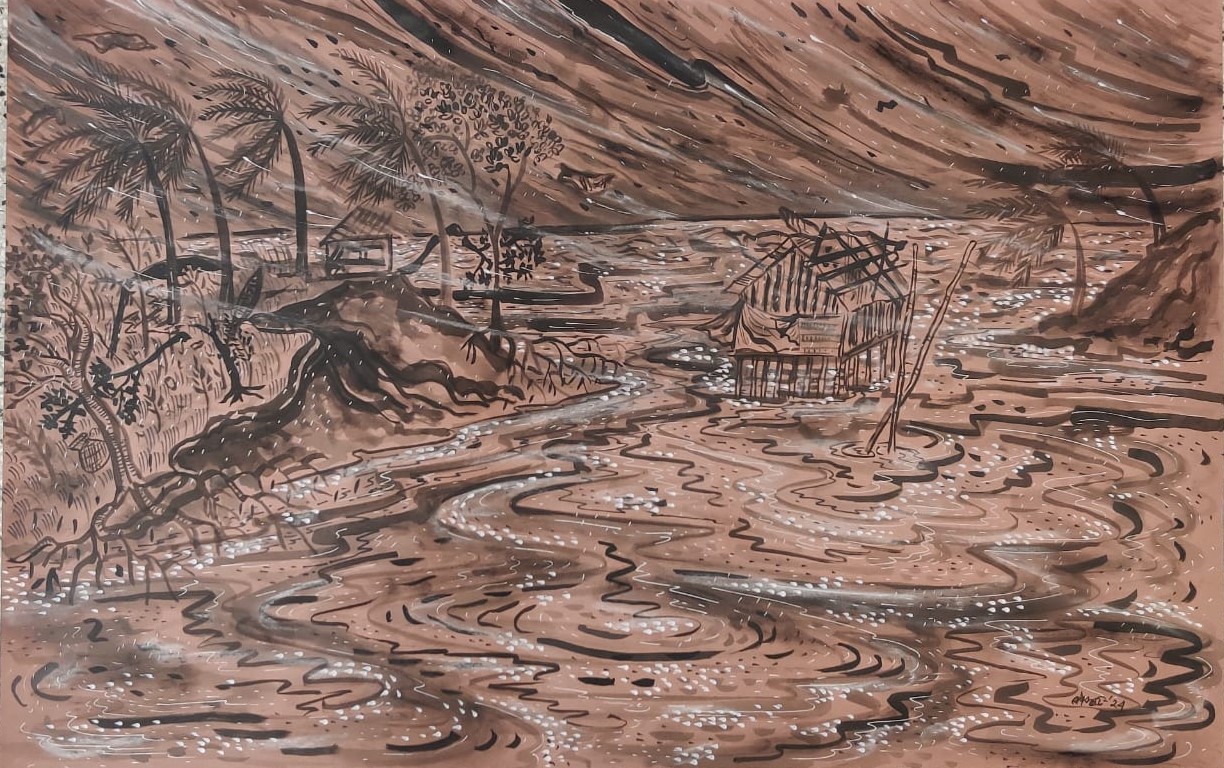
In Pic: The Cyclone by Koustabh Chakrabarty, Ecotone Exhibits
Nowadays, varied forms of eco-conscious fiction are on the rise. It is but a direct reaction to the ongoing climate crisis fuelled by runaway capitalism and majoritarian politics. Alienated childhood, climate refugees, labour crisis, resource-conflict, inequality and the loss of habitats are some of the broad themes that permeate through Kosha-da‘s paintings. Through the “has been” he shows us the “could be”, just like his “perhaps” glimpses into the “if only”. He consciously eschews bright colours, opting for an organic uniformity that resonates between the rust and the soot, the grey and the white. But, what does this muted exposition tell us? Is it our collective existential boredom, and a peek into the future? Does it talk about civilization’s eternal numbness, that nature fails to sooth? Or is it the Buddhist ideal of Majjhimāpaṭipadā that we, as a species, have grossly deviated from?
Even the leitmotifs of ECOTONE are spread across the essential triptych of the Middle Path — here water, playfulness and breath may seem to be at war with civilization, toxicity, and death, but in reality the entire spectrum is desperately held in balance by pixels, survival, and roots. And this, verily, is the ecohydrological pledge of Jaladarsha that strives to rescue us from our own greed.
An alumnus of Jadavpur University, Joshua Bodhinetra is a poet and writer currently working as the Content Manager, Indian Languages at the People’s Archive of Rural India (PARI).
 Jaladarsha