by Shirsho Basu
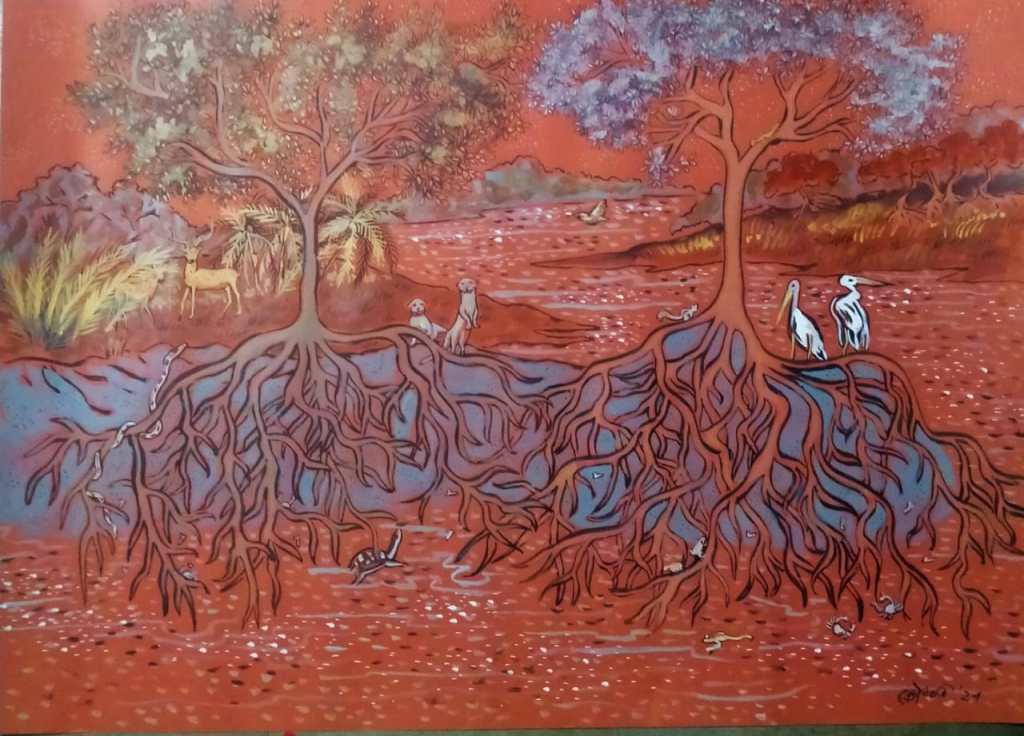
In Pic: Breathing Roots by Koustabh Chakraborty, Ecotone Exhibits
It is a naturally accepted proposition in art history and art-criticism that language, or words are always in an infinite relation with the painting. Words are sometimes rendered so imperfect that when they confront the visible realm of a painting, they are proven to be insuperably inadequate.
In this short meditation, however, I’m going to do such a task with the hope that language perhaps could do justice to the visual artist Koustabh Chakrabarty’s solo exhibition called ‘Ecotone’- a languid eco-political journey through the various different shades of brown, black, and grey and the monotonal ambit of sepia. Erected within the discourse of the Anthropocene, Chakrabarty’s painting here, in close conjunction with the ecological activisms of ‘Jaladarsha Collective’ weaves the epic confrontational relations between the ‘human species’ and the ‘Earth system’, beginning with creating the images of the “breathing roots” of Sundarban, to interpreting the disruptions in the ecosystem as “ecological injuries”. Chakrabarty as a humanitarian artist, collaborating with the eco-political commitments of the ‘Jaladarsha-Collective’, makes it possible to draw the images of torrential rain and storms afflicting the low-lands of Sunderban derived from images from his cognitive memory and collective activist praxis. If “Gluttonous Devouring of Lands” by a giant surrealist demonic creature suspended in space occupies Chakraborty’s poetic mind in one painting, then in another, the “harsh thorns in the mangrove forest” has symbolized the despotic signification of the patriarchal phallus. If one painting deploys Chakrabarty’s phantasmatic one-stroke-technique, then another has elucidated the rooting of life and labour of the marginal lands into the history of the modern ecosystem. Chakrabarty perhaps being driven by the collective’s eco-politics, believes that water doesn’t discriminate at all, and therefore draws the imagery of these “non-discriminatory flows” in a squiggly collection of arboreal roots deeply impregnated into the ‘Earth system’. So much so that in one painting, in order to sketch a different, lethal history of the Anthropocene, the eco-conscious Chakrabarty brings forth the images of the remnants of the industrial societies; inverted human faces suspended in the capitalist miasma; quasi-skeletal structures; the human-child, and a toxic spoon: putting all these things into one canvas, disrupting the conscious-rational syntax of human civilization; deliberately, albeit arduously trying to liberate the human-forms into an imaginary natural condition that is perhaps situated outside of the capitalist air of industrial society. The artist here politically rejects the songs of “birth and rejuvenation” and welcomes, instead, the “cycles of death and deterioration” so as to break with it.
The “conscience keeper”, in Chakrabarty’s artistic eye, or perhaps in his poetic mind, is scavenging for water and air. Thus, the artist is perhaps hell-bent not to let the newborn child grovel within this quagmire of toxic industrial waste as a part of human civilization which is regressing backwards. Quite on the contrary to these regressions, he conceives certain forms of human eye, or perhaps non-human, progressively appearing in history as the conscience of civilization. These are the same decrepit
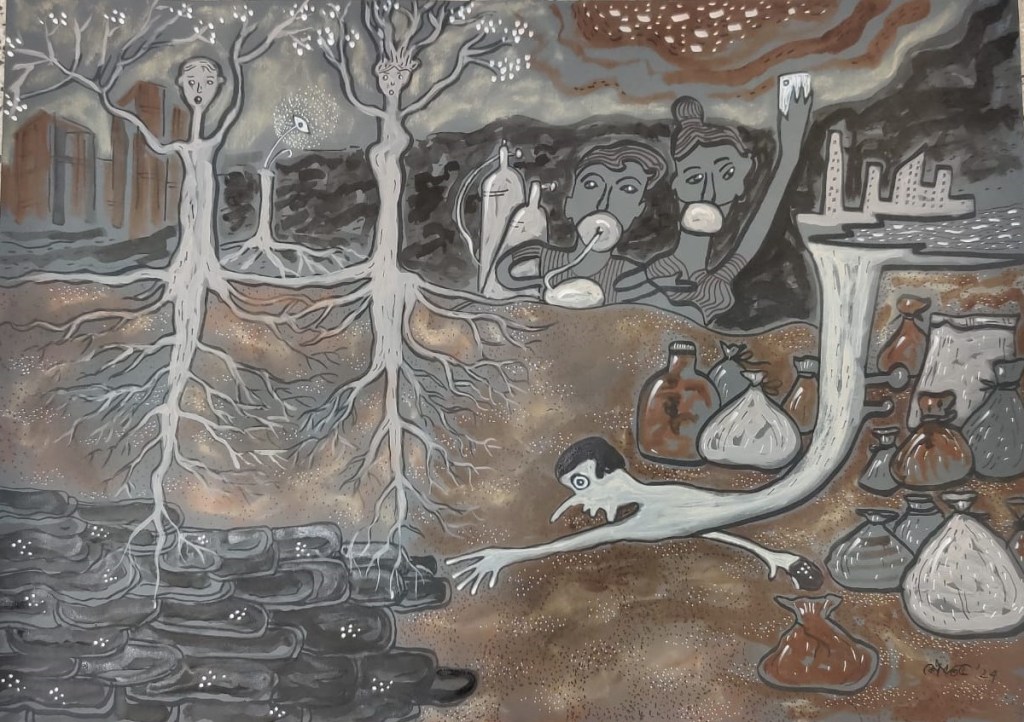
In Pic: Conscience Keeper In A Brownfield Site, by Koustabh Chakrabarty, Ecotone Exhibits
human eyes, in his next painting, which trans-mutate into a heap of garbage as if we have already failed humanity. But, gathering his mind steadfastly, Chakrabarty bucks up; and without letting the weary pessimism stagnate, declares in the final call that he dreams of having, an access to that imaginary ‘Fish Key’ that ceremonializes a moment within the sublime history of the Anthropocene; a moment when our individual human conscience will trans-valuate into a collective conscience, ultimately liberating life, labour, land and bodies from the imminent perils of extinction. It is as if Chakrabarty paints an anthropological fable of a series of human-environment interactions. But still “it is in vain that we say what we see; what we see never resides in what we say.”
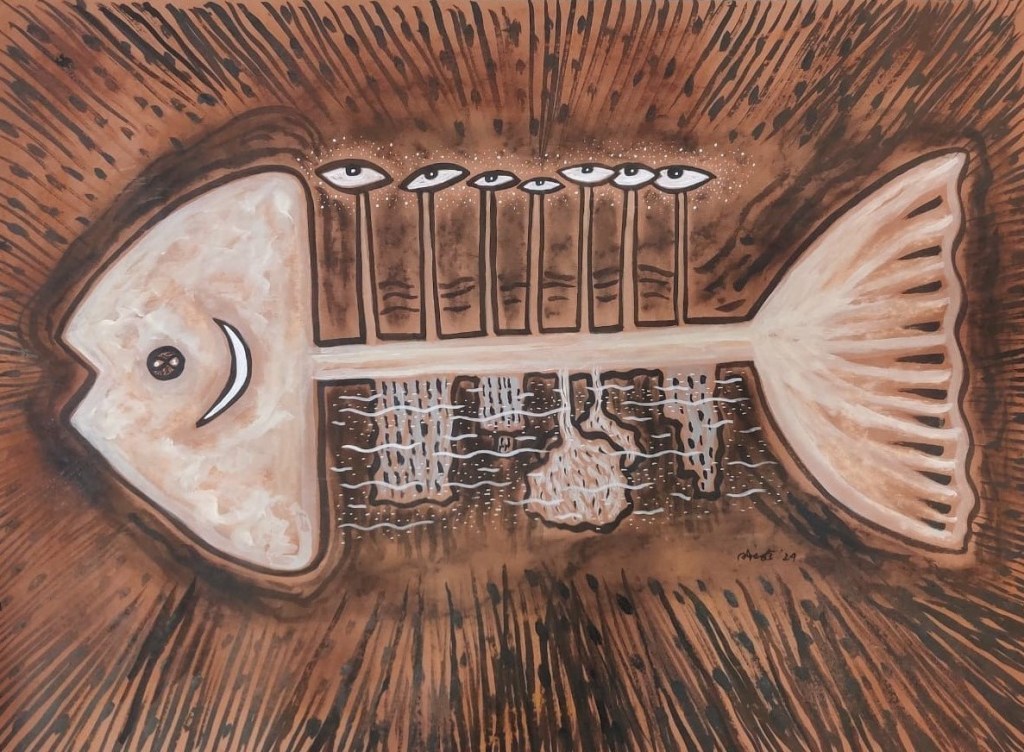
In Pic: The Fish Key, by Koustabh Chakrabarty, Ecotone Exhibits
Shirsho Basu belongs to the School of Cognitive Science, Jadavpur University, Kolkata, India
 Jaladarsha