Tarini Manchanda
Rarely does a journey across multiple Indian states involve only one mode of transport. Typically, if you are neither very wealthy nor extremely hard up, you will be shuffled from train to car, jostled from bus to auto, and when going into the rural parts- often picked up and plonked on to vehicles that can be characterized as the masterful inventions of their riders. It is one of the many signs that one has arrived in rural India, to find a motor vehicle engine that is attached to a fruit cart or any makeshift device that can quietly turn into a roaring and capable vehicle to transport tourists (also), but one that is plying only to enable the travel of locals between village centre and village market, or village market and village centre. This is the story of a journey from Delhi to Kolkata, and Kolkata till the Sundarbans. It is also the story of life in this region that appears grey and quiet on the outside, but holds much joy and fervour on the inside.
It was January, but the sun shone down bright and early, overhead. We were walking across fragmented and muddy islands of lands that one had only heard of in wild legends, and climate perplexations. The mud was dry now, but it looked like it had once been a gooey mass of grey. We were visiting the home of a colleague, Suchita (name changed to maintain anonymity), who grew up in what remained the almost fictitious landscapes and forests of the Sundarbans. Mangroves, gnarly and grey, unlike any other forests, I was told. Beyond this, I had no idea what to expect. Between tigers, and deities, it was difficult to gauge what the people living here would depend on these forests for. We were traveling to the region, to poke into questions about these lands, and how the forest was being used in the everyday lives of locals. How did they depend on the forest, and did it depend on them at all? As more dialogues on forest rights, the jungle and its fragile future open up, what really will be lost, and are people really prepared to lose it all? What else could the future imagination for the region become?
From boat to bank, the journey did involve at least 6 different modes of transport, each of differing duration and usually on water but also on land. Souvik, who was guiding and interpreting as I fumbled to understand Bangla, pointed out that we were to be taking a journey often taken by locals who are returning home to work after long days of labour in the city of Kolkata. Hordes of people would board the trains coming into Kolkata in the mornings, and what seemed like larger crowds would board them in the evenings, to go back home to their villages. It was not unusual then that this journey was interjected by groups of religious sects, asking us to sign a leaflet and declare our faith. What was unusual, however, was that these groups belonged to the Hare Rama and Hare Krishna groups who were traditionally not as engaged in proselyting as they were in singing, celebrating and performing their beliefs with fervour, at least the last time I checked. On this trip, however, their presence was a part of the landscape, sometimes echoing in songs wafting through the cool night air of the Sundarbans. As forests that held creatures known to humans since the time of the crustaceans slept. Odd shaped crabs, in an array of colours, snored soundly in the jungle, the spirits of age-old belief systems came alive, swirled into the night sky, and buzzed around the ears of tired travelers.
Once in the bans, or the forest, one does not experience a sense of awe, but we are in fact nudged to observe the complex root structures of trees, the swirling and knobby branches of the small leaved fauna, and the oddly enigmatic foliage that seem to be standing not on soil or on water, but in mid-air. These small bushy trees are the home to ‘Dakhin Rai’ or the tiger as legend would have it. His evil and hungry roar finds its way into stories, and deities scattered through the islands. Anthropologists have written accounts of complex systems of social cohesion, where the local honey is open to all foragers, and never fully extracted by any one person since it is considered a community resource. This sense of camaraderie between forest adjacent people (not forest dwelling, because actually living in this forest requires the felling of trees and consolidation of lands, and therefore the destruction of forest), between forest adjacent people- is a well-known parable, ethnographic curiosity and it emerges in the many instances of ones’ experience on the islands. That the bounty of the forest doesn’t belong to any one person was made clear even in Ghosh’s ‘Tigernama,’ a story based on folk tales, warning readers of the punishment meted out to those who seek to plunder the jungles of its plenty beyond acceptable limits. With Bonbibi starring as the justice minded, religiously syncretic version of a goddess, the story holds many metaphors and ideas to allow a new reader to understand the region and its people with some depth, if they choose to do so.
To me, the idea of thousands of people traversing these landscapes as part of their daily routine was still almost unbelievable. How did they live in these fragmented and precarious lands, at all? What was the story of survival? How did they eat, live, feel and think about their connection to the forest? How did they love, make friends, and socialize? We were soon to walk into answers to these questions, but not before a good number of hours were spent sitting in boats and watching the commuters ply between the banks of various islands. Not before a pleasant dunk in one of the many ponds found in almost each home of the Sundarbans.
But before we get to the ponds, we must dwell on the boats. To get across the islands of the Sundarbans, locals take boats that usually carry up to 100 people per journey. Each commuter walks on to the passenger boat, these don’t seem to have names, only motors that carry the boats to and fro. Travelers find a spot on the wooden rim to rest on. Once settled in, they can gaze off into the distance as long as the boat meanders its way through the waters. These naturally ordained mental health breaks with the air of the Sundarbans were common through the journey, as was the cosy and packed deck full of people. While the boat makes some sound in its movement, the air is thick and the space is wide enough for you to forget it.
If I take a moment to compare this experience with that of a bus, the mere difference begins at the ticket. For buses, travellers will spend some of their time waiting for the conductor, and to pay for their ticket. Then, depending on the length of their journey, they get to stare into the distance. In this scenario of the wooden and muddy boats, the tickets would be paid for upfront, and so, the journey was spent in silence, allowing me to wonder what people were thinking about. Perhaps they are forgetting that they are on a boat, and thinking of what they would cook for the family that evening, maybe it goes deeper- maybe someone is working out what their grandmother said to them in childhood, perhaps it is just about the next day’s Jatra (local festival of deities and theatre)? Instead of presuming, it was necessary to take a glance around the boat which revealed all kinds of people and their cargo.
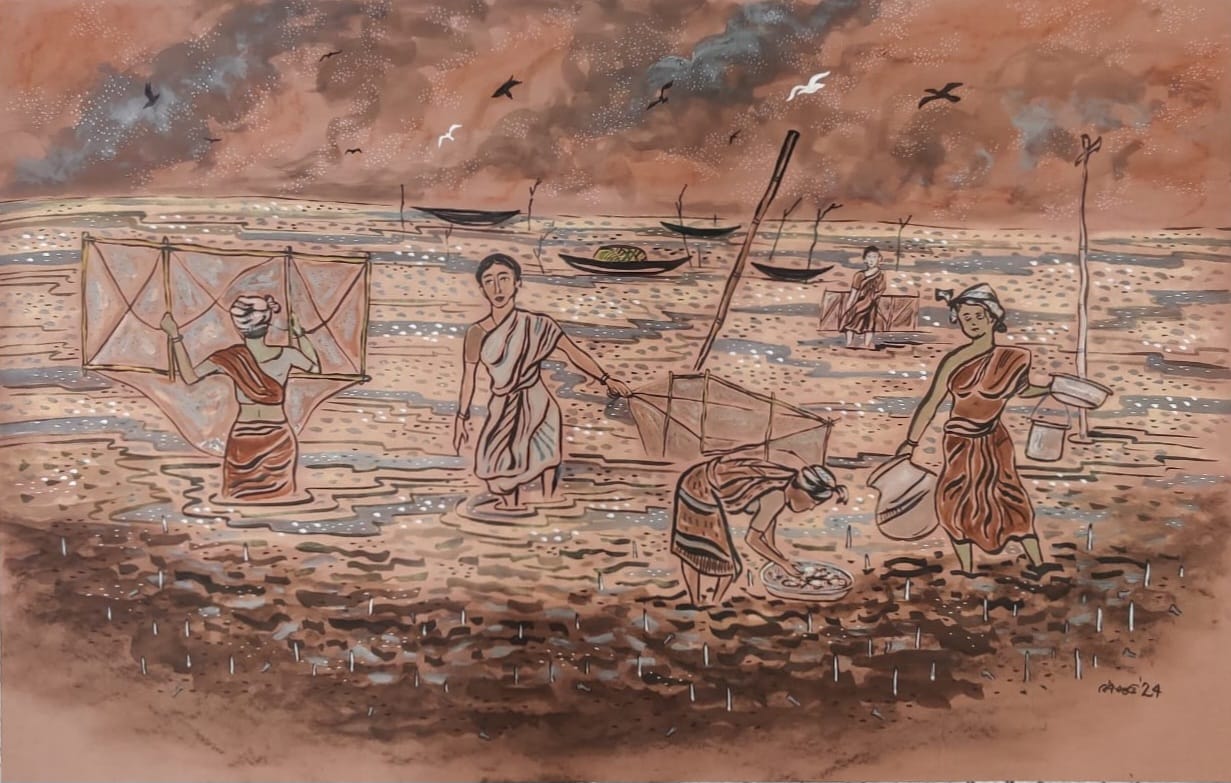
Sometimes, the cargo was large poultry, groomed for a cock fight, other times it would be bamboo, old water pumps, bikes, bags of vegetables, biscuits, all kinds of treasures were nestled in corners of these floating structures. Bags upon bags containing the aspirations of families trying to make lives out of their existence on the bare islands. Why would they want to live here? I asked myself. Why not leave when you could see the river rising and falling to engulf and then recede away from your home? It was, after all, the Hungry tide that we were looking at. Just as one boat was about to dock, I found myself running to capture the well-timed fishing net, thrown into the air by fishermen on the shore. At this moment, nearly everyone on the boat suddenly became invested in my quest. I clicked, only to capture the net in mid-air, and as I looked away from the camera, at least 5 strangers asked me if I had been able to capture the image. It was a truly local experience. One that I will make more of later.
In his book, ‘The Hungry Tide,’ Amitav Ghosh tells the story of these islands across time, social hierarchies and space. As his protagonist makes his way to an aunt’s place in the bans after years, he notes: “The freshly laid silt that bordered the water glistened in the sun like dunes of melted chocolate. From time to time, bubbles of air rose from the depths and burst through to the top, leaving rings on the burnished surface.”
To me, an outside observer, none of these nuances were visible yet. It was merely water, grey sands, colourful sari, and noisy tourists- until I really looked. The pleasure of ignorant binaries and quick judgements didn’t last long, Suchita’s family took us in with warmth and affection. We were guided into a realm of slushy pond floors and lazy crabs stretching their arms across the cool of the water to move into a different rock crevice, and to do it sideways.
It was mid-day when we arrived, the embankment was about 5 ft tall, the water was definitely shimmering and I was standing on the fabled melted chocolate that looked like it had spent too many days in someone’s cupboard, saved perhaps for a special day. Suchita’s mother was gesturing for us to come inside, as she would feed us crabs fresh from the forest. Aside from the food, the wooden beams supporting the home, the medicinal plants such as Keora, fish and honey were brought from the forest by those who dared to visit the depths of the jungle or what was locally called ‘deep jungle’ in Bangla.
In the coming days, I would visit the local Jatra or play festival in a local Sari, make a trip to the forest department’s cordoned off reserve areas, and a tourist resort where we were accompanied by a boat full of loud Delhiites, aching to meet with Dakhin Rai, the fabled and much loved. These, however, are stories for a different blog, and a different day, for now we must rest into the slush of the muddy ponds and cool down, really quiet down, to slowly begin to enjoy the many memories of this journey.
To truly understand life in the Sundarbans, would take years of experience, time and observation. However, a few days on the island of Choto Molla Khali revealed an existence that was at the same time idyllic, survival oriented, bounded in plenty and much more. Through walks across the islands at various times of day, conversations with local residents, and a stay at the childhood home of our colleague, we became familiar with some of the rhythms of everyday life in the area.
Suchita’s mother lives with her own mother, her daughters and mother-in-law, while her husband is away in the city, working. Her day is spent procuring the main meals, and caring for her family and shop. She is a strong person, in charge of much around her and resilient in ways that one can only imagine. Suchita’s mother is not only a shopkeeper, bookkeeper and well-known throughout the island, but she also does occasional farm work. Over the course of our visit, she told stories of cyclone Aila and how it swept away the house, but she made sure we were safe, well fed, entertained, socialised, and warm in our time there.
This very small peak into the lives of some of the residents of the island of Chhoto Mhola Khali was insightful. A morning on the island begins early, as fisher-people (irrespective of gender and age) take boats out into the forests. These boats are gone by the mid-mornings when we take walks in the area. Shops have opened their doors, and families who stay back are either managing fields, looking after fishing nets that have been placed strategically to catch some fish over the course of the day, or managing household tasks such as preparing meals or fishing in the pond for the morning meal.
While many of these activities are dependent on a lifestyle of subsistence, we learnt that a growing tendency in the area is to find employment outside the islands and as labour in the cities. In the case of one family, the younger daughter’s school fee was quite high, but her father was unwell. Despite his ill-health, or perhaps to recover from it, he had taken a boat into the fabled jungles to hunt the forest bounty. Stories of his visit were told as a form of sacrifice, as plying boats into the jungle remains difficult for both practical and social reasons. People who ply out into the waters often require permits that can be too expensive for them (some accounts mentioned that permits cost between Rs. 1000 and others at Rs. 80,000). Accounts of people who go into the forest were usually connected to some form of compulsion or low income levels. For instance, Suchita’s grandmother explains that one of her husband’s companions. He would go into the forest despite his old age, and even lost an ear to an “accident” or encounter with the tiger. Such stories are not uncommon, often accompanied by almost fairytale-like detail, where the tiger’s mouth is sealed, or people get sacrificed. In this mingling of reality, emotion, imagination and folklore, it is not necessary that every story be entirely rational or truthful, but its telling and each rendition adds a layer of mystery and some shape to this ethereal and largely neglected region.
While a real hunt in the jungles of the Sundarbans remains an enigmatic expedition to the outsider, we were able to catch hints of these journeys both in the literature of Ghosh, but also in moments on a tourist boat. Standing on the tourist boat of a lodge, we noticed a small fishing boat frantically paddling away from us. Those inside the boat seemed extremely worried, and scuttled away into the bush in the mangroves, almost hidden away from view. A similar encounter takes place in The Hungry Tide, but in this case, the boat people have to lose their day’s catch and some money to the highhandedness of the forest guard. Thankfully we did not get close enough to cause any harm to the fisher-people. The small boat and its inhabitants seemed extremely vulnerable in several ways, as they rowed away frantically rocking the boat from side to side. The vulnerability lies either in the risks of their work, the penalty for those who ventured outside of demarcated areas, and in the stories of instances wherein hiding from the forest guard patrols could often land them in trouble, if it didn’t take them closer to the jaws of the tiger. Even as many of the fishing boats spent days on water looking for their catch, and away from the island, we did get to see a glimpse of one boat just as it left the shores of Chhoto Mhola Khali. This boat was simple, made of wood, bamboo and tarpaulin, it had a small stove, some tools, torches and the implements to last its deckhands some days out in the waters. The tourist boat, however, was much larger in comparison to the one being used by fisherpeople. Since the journey on a tourist boat was loud and stayed away from the smaller streams and islands, we were not too bothered by tiger sightings, partly also because the boat guides mentioned that tiger sightings often happened only every 6 years, and therefore not often enough to be significant.
Suchita’s grandmother, however, recounted the memory of a time when tigers were not so far away. She explained that her elder son, who would visit the forest, had many run-ins with the great Dakhin Rai. Although the tiger is now seen as a creature that lives very far away, there was a time when the threat of attacks was much closer to home, but the jungle also presented a larger bounty.
“My eldest son still goes to the forest. He catches fish and crabs. However, her grandfather used to collect honey and wood. He also brought wax and fruits of Hetal, Keora, and Taru Phal in large quantities. Mostly they collected wood and sold it. Tigers used to come often to the villages back then.”
In such accounts, the story of the tiger’s presence is only as a predator, however other accounts that we encountered in the time we spent walking across the island expressed the deeper connections of wildlife to everyday imaginations of the space, of social relations and much more. For instance, a couple living in Kumirmari explained their long standing belief in Bonbibi, and told us the syncretic origin story of the goddess protector of the forests. It was through these encounters as people went about their days, that we learnt a little about the imagination and practical life in the region.
Finally, as the day was turning to dusk, people went back home from boat making, or drying fish and other activities, to spend time with their families, eat or prepare meals. While the social structure resembles that of other communities, what struck me was that young men and women living in the Sundarbans are adept at plying boats across the River, at all times. It was Jatra season, which is a time of festivities, and many people were attending local celebrations in the form of plays, music and storytelling. To attend the festival, however, families would dress up and venture out and take boats across the currents of the River. These moments were spent in moonlight, with waters that swayed us only a little, navigated by the youth who were keen to spend a night being entertained. While the performance didn’t live up to their standards, and presented itself as a night of much less fun than imagined, the young people found a way to connect with one another, to speak and have a night off away from their other responsibilities.
In these moments, across rivers, it was evident that the Sundarbans is just like any other place in its human stories, and yet it is a unique plethora of art, culture, syncretism, imagination and much more.
 Jaladarsha