Adrija Bhattacharya and Bedoprana Roy
6/03/26
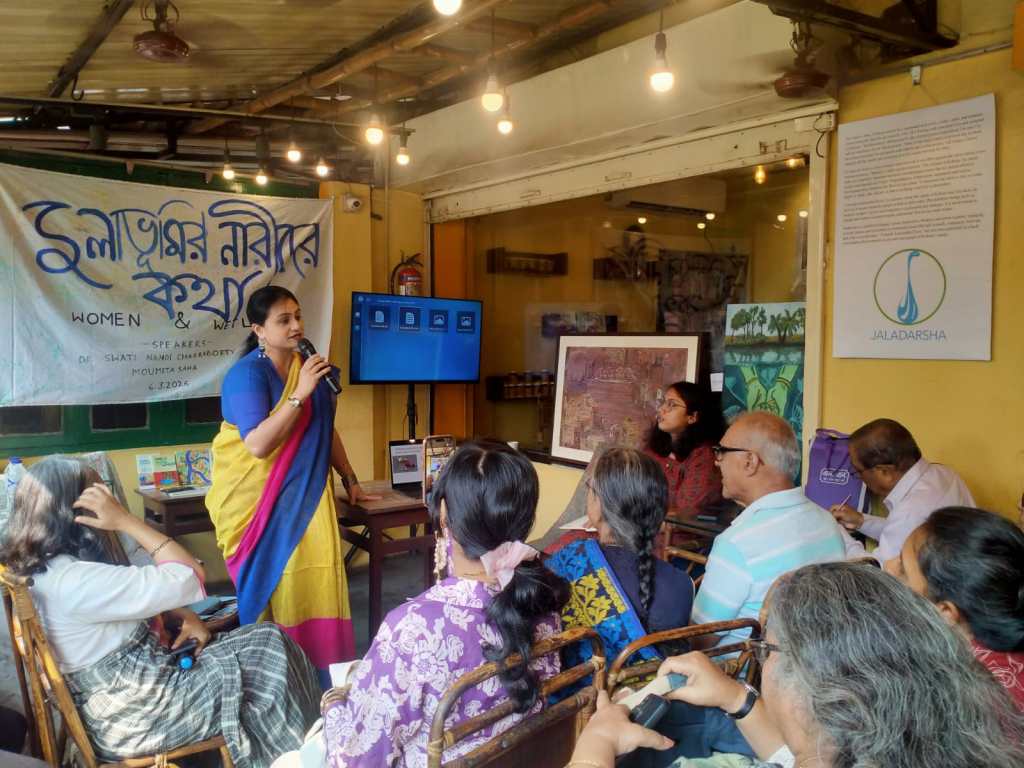
Jaladarsha hosted an event titled Jolabhumir Narider Kotha on 6th March,2026 as part of their ongoing series of events titled “Towards Sustainable Flows” in collaboration with Travelistan cafe. The event was filled with enriching conversations that put the women community members as central to the tale of East Kolkata Wetlands. The event started with initiative lead – Sayantoni Datta’s remarks on how Jaladarsha aims to create a space for people who care for the city and is heading towards establishing an intergenerational collective subsequently. She recalled previous events in the series where a wetlands walk was conducted and invited the speakers – Dr. Swati Nandi Chakraborty and Moumita Saha for exchanging ideas with everyone present.
Dhruba Dasgupta (Professor and activist, part of the organisation SCOPE ) was cordially invited to share her thoughts on the current issues of wetlands and how we can think of a way forward.
Dhruba Dasgupta began by thanking her guru Late. Dhrubojyoti Ghosh who was an environmentalist of the poor and had an immense contribution for developing the waste-recovery system out of the East Kolkata Wetlands. She mentioned how the existence and sustenance of EKW resonates with a history of strong resistance. In her words “Jolabhumi sundortomo bastutontro” suggestive of the creative ways that the natural system is itself crafted and stressed on how we must protect it. For the question of women, she said that women of the wetlands are constantly used for their vulnerability. The land sharks threaten the women to exert power and continue encroaching on the wetlands.
We also had community member Ashok da, who works in Boro Gopeshwar bheri and has been actively involved in various movements against encroachment related problems and regarding rights over the wetlands. In his speech he acknowledges that through declaration of EKW as a Ramsar site, different local communities – adivasis, rajbongshis and muslims have gained some sense of visibility internationally. He calls for people to stand beside the farmers, fishers and people whose livelihood are dependent upon the wetlands. He says that they are currently planning to open a new office near Bantala. To him, a substantial amount of sewage is desired in the bheris so that farming becomes abundant and lack of sewage being supplied to the bheri is a pressing issue there right now.
The next speaker was Moumita Saha who presented snippets from her books that are based on 40 years of intense research. She focussed on social history and the need for it to understand the aqueous history of Kolkata. She explained to us how women of the wetlands engage in making of katha, an art tradition that involves intricate stitching on fabric. Besides, women are also involved in making silver jewellery. She highlighted how our idea of Salt lake has shrunk over the years based on rivers changing its course and process of urbanisation and its consequent
impact. She highlighted the traditional techniques of fishing, farming and how the making of wetlands area as a habitable land has been the result of hardships by very marginalised Rajbongshi communities. She ends her presentation by referring to her books on the development of New town & Rajarhat and also of Dumdum where she has documented micro-histories that argue that Kolkata’s past is around 3000 years old unlike what is believed to be 300 years. To summarise her talk, she indicates us to create histories by giving agency to the people – dispossessed and vulnerable instead of focussing on the history of kings and landlords.
After this, Dr. Swati Nandi Chakraborty who is a professor of Science and Technology, started the discussion on microbial biodiversity of the EKWs and how exploration of the same accelerate ecological balance and can also be utilized for industrial usage. She explained that women become prominent agents around waterbodies. They are employed in the wetlands for cleaning water hyacinths. Dr. Chakraborty stated how she is trying to look at economic participation of women in this regard. She looks at the importance of women’s role in planting and nurturing plants that help in remediation of heavy metals that get deposited in the bheri areas. In her discussion key points were raised about gender related issues in the wetlands like – claim over land rights, decision-making in both household and politics, unequal access to resources. She highlighted how women dedicate most of their time to wetlands and restoration processes across the globe but due to systemic injustices they are slowly becoming vulnerable subjects of climate change. This issue of making a population climate refugees is a matter of great concern for the civil society too and therefore needs intervention through collective action and policy based changes. In her pathways towards women empowerment in the wetlands, she recommends –— Joint rights on wetlands, skill-training and collective action to support women working in cooperatives so that they can have better control over their income, access to banks and loans, etc. Lastly, she introduces the prospects of a circular economy to the table and the need for incorporating it as an alternative.
The sessions ended with insightful questions from the audience and folk songs — songs of women, and songs for women by Chandra Mukhopadhyay. The songs that celebrate the imagery of working women and their struggles ultimately made the day brighter, wholesome and thoughtful from all aspects possible.
 Jaladarsha