Sayantoni Datta
Photo credit/Field notes: Polash Mondal and Ankita Mondal
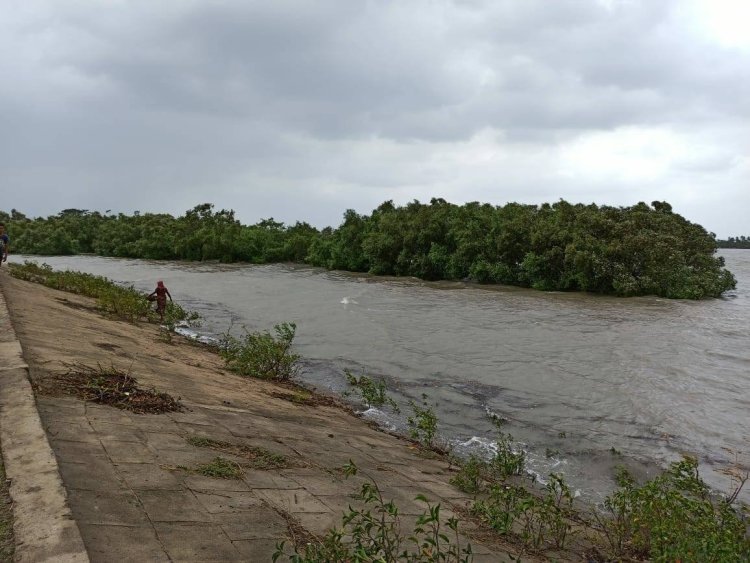
Kalitala, a coastal village in Hingalganj block, suffered far less where most other places in the block are badly affected during Cyclone Yaas, 2021.
Ankita Mondal who is born and lives in Kalitala and volunteers for the Jaladarsha collective writes, “ Residents say that the village has been suffering from Cyclones such as Aila in 2009, Bulbul and Amphan in 2019 and 2020 and now Cyclone Yaas in 2021. These cyclones have been a repetitive occurrence over the past few years and the village faced several problems- like food scarcity, drinking water scarcity, fuel scarcity, loss of safe shelters and suffering from disease. Learning from past events, they are consciously tackling the current situation.”
She writes, “When the storm was forecasted the community was quickly alerted to making preparations. What were these actions? They stored drinking water, since electricity connections are interrupted after the cyclone. Requests were made to Panchayat and Block officials to release excess drinking water supply and the same was stored at home and at the flood centres. Dry food and medicines were stored for the time period that people would need to take shelter in the relief centre or other safe places like the school, or “pucca” houses with all their necessary things and important papers with them. Masks and sanitisers were distributed at the relief centres”.
Due to joint efforts of the villagers the village was saved from floods as the river embankment was not broken.
Local people say, “A mangrove forest which is planted by the local organisation has acted as a natural barrier here. It has saved the embankment by lowering the wave level”. They say, “if this forest didn’t exist the village would have been flooded, the embankment broken. This incident proved that early disaster awareness can reduce the level of disaster, and planting mangroves with well planned embankments can save the Sundarbans from natural calamities.”.
The story of the mangrove afforestation efforts
Cyclone Aila had brought untold devastation to the region in 2009. In late 2012-2013 almost three years later, a small team of environmental activists including myself visited some of the affected areas. Every time we went and spoke about the disaster, people in Sundarban kept pointing further south. We finally reached Kalitala, a small compact coastal village, every bit like an island community on the south eastern most tip of the delta. It was clear that nothing much reaches here, and often the island gets cut off from the mainland when there is a calamity. At that time the village was entirely run on solar lighting and not connected to the mainland’s electricity grid. It took much longer to get there, as road infrastructure and bridges were far less.
After several discussions about what can be done in the Sundarbans, along with supporting local livelihoods of women, an experiment was initiated with the community based organisation on mangrove afforestation, organic farming and nursery gardening. While most of the residents chose to work with nurseries and vegetable farms, one women’s group and the community based organisation, decided on a collaborative initiative of mangrove afforestation. This would in no way bring returns for the women’s group, but we applauded them for the ‘social work’ they had decided to do for their community with the CBO. A small grant support was given by the Global Green Grant Fund. Today the afforestation area covers almost a kilometer along the embankment at the Kalitala-Ghumti area lying between the two Panchayats Kalitala and Gobindokathi in Hingalganj block, North 24 Parganas.
Learning while planting
The process was initially met with failure as mangroves are delicate and usually grow best under natural conditions. The group had to explore which mangrove species would grow best. The traditional ‘Keora” species did not grow, but Byne species in the second round of attempts grew well as seen in the picture, Goatery is a cheap low cost livelihood for most people in the Sundarbans. Protecting the mangroves from their grazing was and continues to be the biggest challenge.
While “Keora” is difficult to plant, the group has been able to create better saplings with a few more efforts. The local agriculturalists and environmentalists, specifically the area’s green hero Tarapada Gain known for his artful green fingers, is recognised by even his trainers as one of the most successful nature workers in the area. Tarapada has in all these years of preparing mangrove saplings and other extinct species like the “Sundari”, gathered the ingenuous knowledge of ensuring the saplings survive. The organisation is particularly skilled in choosing the right places for afforestation so the mangroves may thrive. Once they grow and spread, it takes its natural course. Polash Mondal, leader of Sundarban Unnayan Bhawan explains, “The mangroves act as barriers for the waves that hit the embankments. Instead of crashing on the embankments, they are held and stopped by the forested growth, and hence hit the embankment with reduced spate. In several pictures of Yaas, you see human beings holding onto the embankments with polythene mud-filled sacks protecting them from waves. This they are doing to prevent the embankment from giving way. Here near the Kalitala-Ghumti embankment, in the experiment of about 1 km, over a 500 square feet, we see how the mangroves have protected the embankment.” The hard work of the organisation has finally been recognised by local people, who watched how the waves were stopped by the mangroves during Yass. A short celebration amidst all the suffering is that finally the people in Kalitala have noticed the importance of this effort.
To shift the narrative beyond relief and embankments every year a calamity strikes we have to begin to understand the natural fury of the Sundarbans, and respect it. This means finding natural solutions, non market solutions to the extremities of nature in these parts.
While most certainly conservation efforts may act as critical alternative livelihoods for people here, a continued pursuit of finding better ways to naturally survive in these conditions must be explored. For those supporting efforts to improve the life and livelihoods of people a long term commitment to stay with and understand the lives of people and the uniqueness of this fragile eco-system is required.
 Jaladarsha