Farmers’ Voices from the Sundarbans: PART- 2

By Pijush Dutta, field assistance Romesh Mondal

Location, Krishi Mela, Panitor, North 24 Parganas

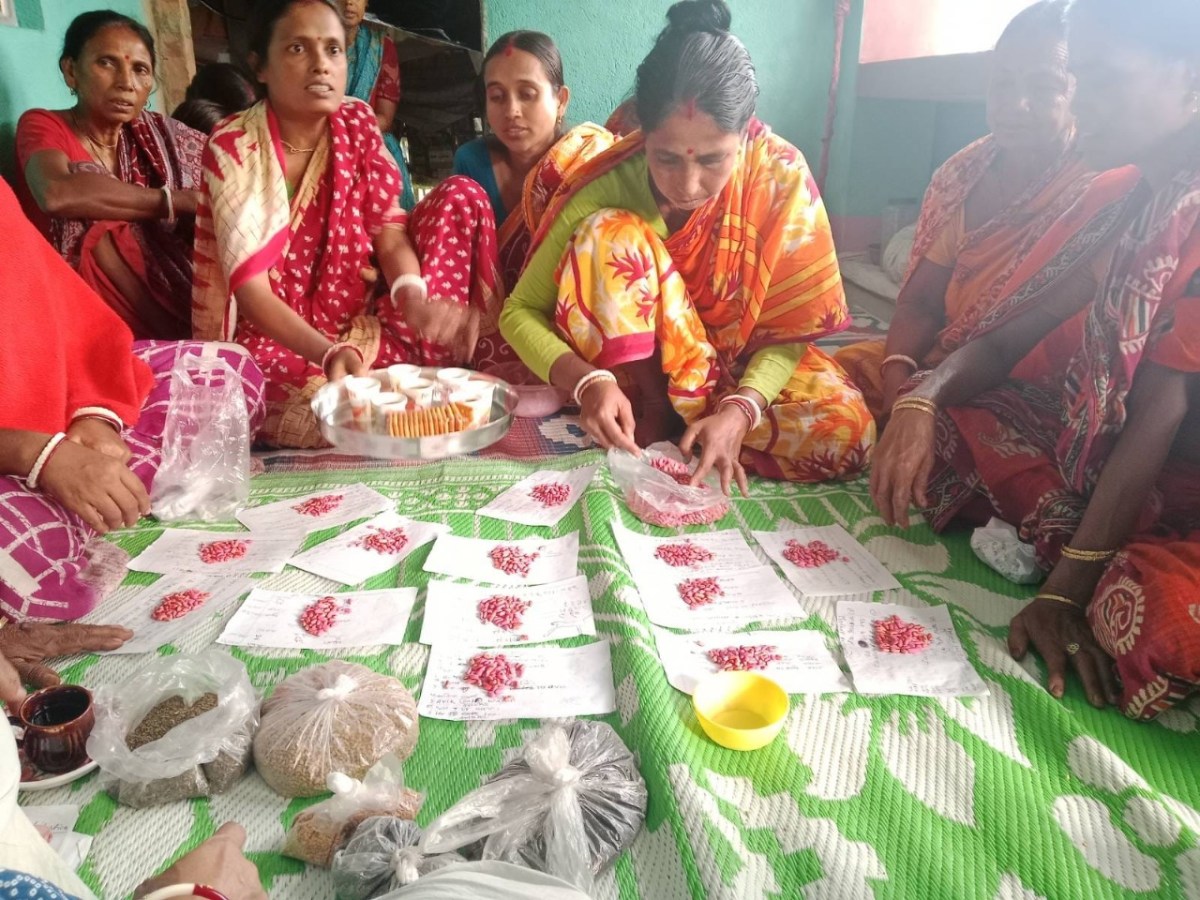
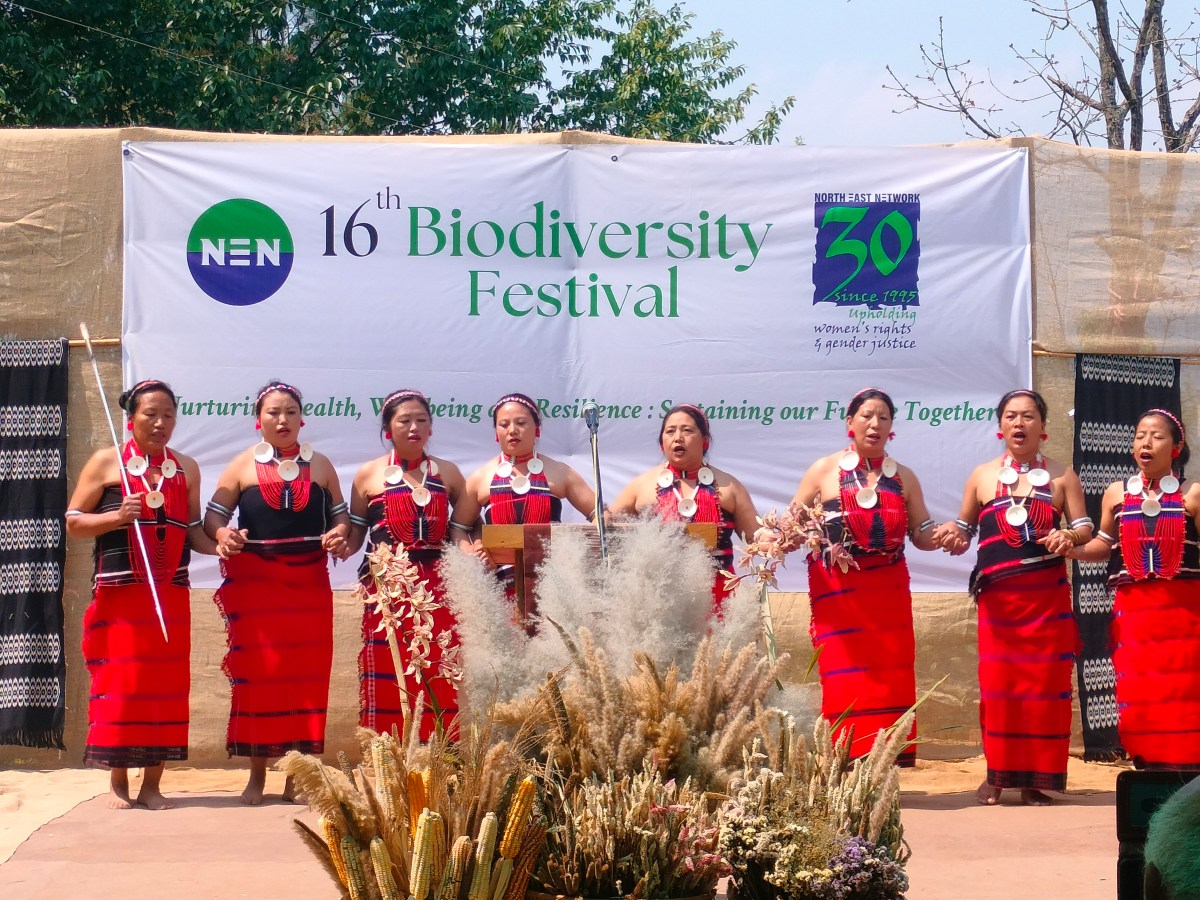
The following piece is part 2 of a set of farmer voices, where we try explore the kind of choices farmers are making, specifically to strengthen our perspectives on chemical free farming. The farmers interviewed in this piece were all participating in a Krishi Mela, or seed festival organised by Paschim Panitor Unnayan Samiti(PPUS).

Satyajit Sabar, a 19-year-old boy from the Sabar community in Purulia, shares his thoughts and experiences in this interview. The Sabar community, traditionally forest dwellers, has recently shifted its focus toward agriculture.

Interviewer: What is your name?

Interviewee: Satyajit Sabar.

Interviewer: Where do you stay?

Satyajit Sabar: I live in Fuljhore village in the Purulia district.

Interviewer: The Sabar community, are they traditionally associated with farming?

Satyajit Sabar: We Adivasis have traditionally been forest dwellers, living near forest areas. However, our organization, Pashchim Banga Kheria Kalyan Samity, introduced agriculture to us.

Interviewer: Are people in your community getting more involved in farming now?

Satyajit Sabar: Yes, many in our community are now successful farmers.

Interviewer: What do they mostly cultivate?

Satyajit Sabar: Tomatoes, brinjals, and almost all kinds of vegetables are grown in our region. Paddy is also cultivated on our land.

Interviewer: Do you or your family own any land?

Satyajit Sabar: Not everyone in our community owns land, but some do have small plots. Those with land cultivate their own plots and often lease additional land for farming.

Interviewer: Do you own land?

Satyajit Sabar: Yes, we own land.

Interviewer: How much land do you have?

Satyajit Sabar: About 15-16 decimals (0.15-0.16 acres).

Interviewer: Is it monoculture land?

Satyajit Sabar: No, we grow a variety of crops. Except for pointed gourd, almost all types of vegetables and crops are cultivated there.

Interviewer: Do you personally participate in farming?
Satyajit Sabar: I don’t farm directly, but my family members do. I help the elders with farming activities.

Interviewer: Does your family lease land for farming?

Satyajit Sabar: Yes, we lease additional land for farming.

Interviewer: How much does it cost to lease land?

Satyajit Sabar: It depends on the quality of the land, but I don’t have a clear idea of the exact cost.

Interviewer: You mentioned that the Sabar community was traditionally forest dwellers. When did they start farming?

Satyajit Sabar: I didn’t see farming when I was very young, but by the time I was about 10 or 11, I noticed people in our community engaging in agriculture.

Interviewer: How old are you now?

Satyajit Sabar: I’m 18-19 years old.

Interviewer: So farming in your community started about 7-8 years ago?

Satyajit Sabar: Yes, that’s correct.

Interviewer: Do you practice organic farming in your area?

Satyajit Sabar: Yes, organic farming is mostly practiced in our region.

Interviewer: There is a water crisis in Purulia. How do farmers deal with this issue?

Satyajit Sabar: To address the water crisis, some farmers cultivate land near rivers.

Interviewer: Considering the water scarcity, do farmers arrange shallow water pumps?

Satyajit Sabar: Not everyone can afford shallow pumps, so farmers often rely on dams for water.

Interviewer: What dams are present in your area?

Satyajit Sabar: There are several big and small dams, along with rivers.

Interviewer: Can you name the rivers in your area?

Satyajit Sabar: They are mostly small rivers.

Interviewer: Do people in your community still depend on forests?

Satyajit Sabar: Yes, we have a deep connection with the forest and depend on it for various resources.

Interviewer: Are more people shifting to farming, or are they still reliant on forests?

Satyajit Sabar: Most people are now actively participating in agriculture.

Interviewer: Is everyone practicing chemical-free farming?

Satyajit Sabar: Yes, most people practice organic farming. However, in rare cases of low production, they may resort to using chemicals.

Aparna Das, from Kalinagar Gram Panchayat, Ghoshpukur Village, Block Sandeshkhali 1 and Mousumi Maity Khamari from Sulkuni village, Bhabanipur Gram Panchayat 1, Hasnabad block present at the Itinda Panitor Seed Festival agreed to share their insights with us.

Interviewer: How long have you been associated with organic farming?

Aparna Das: We have been associated with organic farming since the time of our forefathers. However, as market demand increased, we had no other option but to depend on chemical fertilizers. Over time, we noticed a rise in various diseases, which we believe was linked to the growing reliance on chemicals.

Moreover, the cost of farming increased significantly, and we started losing control over our practices. Then, various organizations came to our village and promoted the benefits of organic farming. This encouraged many of us to return to organic methods. However, there’s still a challenge. Some farmers practice organic farming while others continue with chemical farming. Since there are no proper boundaries between fields, water from chemical farms flows into our organic plots, especially during the monsoon, causing damage.

Interviewer: Where do you live?

Aparna Das: I live in Kalinagar Gram Panchayat, Ghoshpukur village.

Interviewer: Is that in Sandeshkhali?

Aparna Das: Yes, it’s in Sandeshkhali 1 block.

Interviewer: What is your name?

Aparna Das: My name is Aparna Das.

Interviewer: As you were saying, water from chemical farming flows into your land?

Aparna Das: Yes, I practice organic farming, but during the monsoon, overflow from nearby chemical fields contaminates my crops. Otherwise, my farming is entirely chemical-free.

Interviewer: How much cultivable land do you have?

Aparna Das: Five bighas.

Interviewer: So, you don’t use any chemicals at all?

Aparna Das: No, I don’t use any chemicals.

Interviewer: What type of land do you cultivate?

Aparna Das: It’s double-cropping land.

Interviewer (to another farmer): How much land do you have?

Mousumi Maity Khamari: I have two bighas.

Interviewer: Where do you live?

Mousumi Maity Khamari: I live in Shulkuni village, Bhabanipur Gram Panchayat No. 1, under Hasnabad block.

Interviewer: Do you also practice organic farming?

Mousumi Maity Khamari: Yes.

Interviewer: Do you face the same issue as Aparna, with water from other fields flowing into yours?

Mousumi Maity Khamari: No, I cultivate on elevated land, so I don’t face that problem. Instead, water from my field flows into other fields.. (laughs)

Interviewer: Is there a difference in farming methods between elevated and lowland areas?

Mousumi Maity Khamari: Yes, definitely. The crops grown in lowlands are entirely different because waterlogging occurs there. We choose crops accordingly.

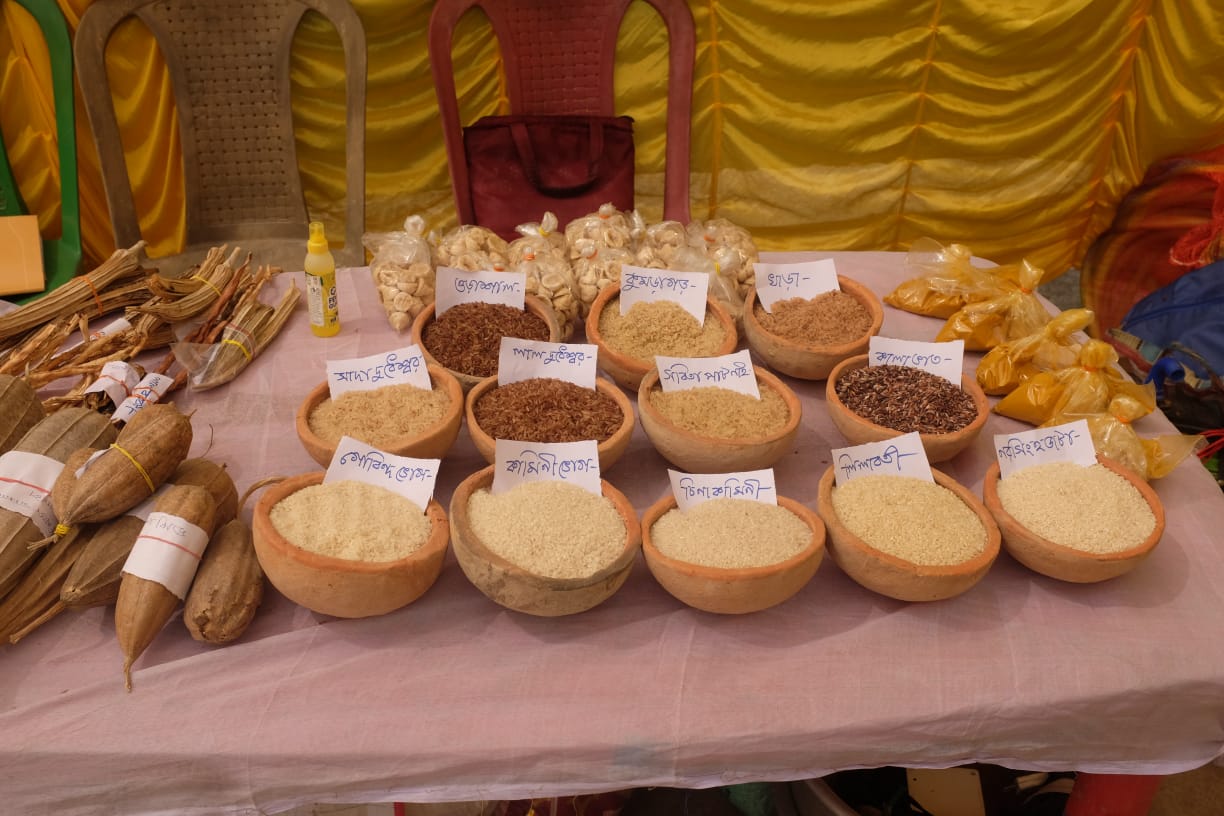
Aparna Das: In lowlands, crops like ‘Khejurchuri,’ ‘Niko,’ ‘Boyarbat,’ ‘Bonkumar,’ and ‘Hogla’ are grown. On elevated lands, we grow crops like ‘Dudheshwar,’ ‘Kaminibhog,’ and ‘Gobindabhog.’

Interviewer: Is the farming procedure different?

Aparna Das: Technically, the procedures are similar, but the crops differ. The duration also varies, some crops take four months to grow, while others take five.

Interviewer: Farmers seem to be moving away from farming. Do you agree?

Aparna Das: Absolutely. We’re struggling to sell our produce due to a lack of proper marketplaces. Despite our investment, we don’t make enough profit. This forces many people to leave farming and seek work outside the state. Women often accompany their families, taking up jobs like tailoring or working in bag factories.

Interviewer: Where do they go?

Aparna Das: They go to places like Tamil Nadu and Bangalore for work. They earn well, which helps them renovate their homes and improve their living conditions..

Interviewer: Do you or your family also go outside the state?

Aparna Das: No, we don’t. But many people in our area do.

Interviewer: The farming methods your forefathers used must have changed significantly, right?

Aparna Das: Yes, they have.

Interviewer: Can you explain this shift?

Aparna Das: In the past, our forefathers planted one seedling at a time, and the crops grew well. The sheaves were thick. But now, due to unpredictable monsoons, we can’t follow that method. Sometimes we plant seeds early, sometimes late, depending on the rainfall.

Additionally, we often have to pump water from underground. Earlier, they simply scattered seeds on the ground and left them to grow. But if we do that now, heavy rains wash the seeds away or sink them.

Interviewer: What is the importance of indigenous seeds?

Aparna Das: Indigenous seeds can withstand water pressure better. Chemically developed hybrid seeds can’t, they get damaged easily. Organic crops, on the other hand, survive harsh conditions.

Interviewer: Then why don’t all farmers switch to organic farming?

Aparna Das: There are several reasons. Fewer households keep cows now, and without cows, it’s difficult to produce organic fertilizers. The population is increasing, but cultivable land is shrinking. Earlier, families cultivated five bighas of land, now, it’s often just one bigha. These factors make organic farming challenging for many.

Interviewer: Thank you so much to both of you.

During the seed festival, the organizers planned to honor successful farmers who rely entirely on organic farming. One such farmer, Arizul Islam Molla, a man in his mid-30s, was among those felicitated. We had the opportunity to interview him, gaining insights into his perspective on organic farming practices.

Interviewer: What is your name?
Interviewee: My name is Arizul Islam Molla.

Interviewer: You have been felicitated here. How do you feel?
Arizul Islam Molla (Smiles): It feels good.

Interviewer: How much land do you own?
Arizul Islam Molla: I own 5–6 bighas of land.

Interviewer: Do you practice organic farming on all your land?
Arizul Islam Molla: I prefer organic farming. Most of my land is used for it. I’m slowly working to eliminate chemical farming to ensure the future generations are not affected by the harmful effects of chemicals. My goal is to transition completely to organic farming.

Interviewer: Could you tell us how much of your land is used for organic farming and how much for chemical farming?
Arizul Islam Molla: Currently, 3 bighas of my land are used for organic farming.

Interviewer: Most farmers are still reluctant to adopt organic farming. Why do you think this is the case?
Arizul Islam Molla: Although the cost of organic farming is relatively low, the yield is not as high. Still, I believe it’s important for the future generations to embrace organic farming. We need to be aware of the harmful effects of chemical farming.

Interviewer: Is the next generation in your family showing interest in farming?
Arizul Islam Molla: Yes, they are. Since we own land, farming is our primary option. We cannot leave the land unused; it has to serve agricultural purposes.

Interviewer: Many people are moving away from farming and opting for other kinds of work. Why do you think this is happening?
Arizul Islam Molla: Farming requires a lot of hard work, and many people aren’t willing to put in the effort. They prefer more leisure time and want to avoid the daily struggles that come with farming.

Interviewer: Have you observed this trend in your village? Are people moving away from farming?
Arizul Islam Molla: Yes, I’ve noticed that many from the younger generation are leaving farming. They are taking up small jobs or businesses instead.

Interviewer: Do they leave the state for work?
Arizul Islam Molla: Yes, many of them move out of the state to find work.

Interviewer: As a farmer, what would you say about the future of farming?
Arizul Islam Molla: Farming can provide a good income. However, farmers need to save and reinvest their earnings to ensure future growth.

Interviewer: Farming methods have changed significantly since your forefathers’ time, haven’t they?
Arizul Islam Molla: Yes, there have been major changes in farming methods.

Interviewer: Could you elaborate on this shift?
Arizul Islam Molla: My grandfather and uncles used chemical fertilizers extensively. Now, we make and use organic fertilizers, and the results have been positive.

Interviewer: Are you associated with any NGOs?
Arizul Islam Molla: No, I am not associated with any NGOs.

Interviewer: Has this seed festival been beneficial for you in any way?
Arizul Islam Molla: Not yet. They informed us about the festival and mentioned they might provide financial assistance or seeds. That’s why we’re here.

Observations:

The Itinda Panitor Seed Festival created a platform for farmers to come together and discuss the future of farming, particularly emphasizing the importance of organic farming. During the event, we interviewed four farmers, each offering unique perspectives.

Satyajit Sabar shared insights into his community, the Sabar tribe from Purulia. According to him, the economic and social conditions of the Sabars are highly unfavorable. Most members of the community do not own land and work as agricultural laborers. However, Satyajit’s family is relatively better off as they own land and also lease additional land for farming.

Satyajit expressed greater faith in farming as a sustainable source of income for the Sabars, compared to reliance on forest resources. His views align with findings from the paper “The Revival of the Tribal Community by the Concept of S.M.A.R.T. Village: A Case of the Sabar Tribe of Jharkhand, India” (Nazish Abid, Mazharul Haque, and Mohd. Resaal Ansari, June 2022). The paper highlights the socio-economic struggles of the Sabars, noting that they primarily depend on forest resources and lack access to basic amenities such as shelter, sanitation, and water supply.

Additionally, an article by the Keystone Foundation sheds light on the land ownership issues faced by the Kheria Sabar community, stating: “The Sabar families only own the land on which their homes are located. Most don’t even have enough land for small kitchen gardens. All surrounding agricultural lands belong to members of the Santal and Bhumij communities.”

The women farmers’ stall at the festival provided valuable insights into the conditions of farmers in the Sandeshkhali and Hasnabad blocks. Aparna Das, who owns five bighas of land, appeared to be in a better economic position than Mousumi Maity Khamari, who owns only two bighas. Aparna was also more vocal and confident during the interview compared to Mousumi.

Aparna shared detailed information about the evolution of farming practices over the years and explained the differences in crops grown on lowland versus elevated land. Both women highlighted the challenges farmers face, including migration in search of work and the inability of markets to support organic farmers effectively.

Arizul Islam Molla, one of the awardees at the seed festival, expressed optimism about the future of farming. He firmly believes that the future lies in organic farming rather than chemical-based agriculture.

Farmer’s Voices from Sundarbans PART 1

By Pijush Dutta, field assistance Romesh Mondal

Location: Village Gobindokathi, Hingalganj block, North 24 Parganas

The following piece is a set of farmer voices from Sunderbans, where we try explore the kind of choices farmers are making, specifically to strengthen our perspectives on chemical free farming.

Kakali Munda, a resident of South Gobindakathi village, belongs to the Scheduled Tribe (ST) community. Her family owns only two bighas of cultivable land, which is insufficient to sustain them. As a result, they are compelled to seek work outside the state. Kakali Munda shares her thoughts and insights on the condition of the ST community in her village.

Interviewer: What is the name of your village?
Kakali Munda: Dakshin Gobindokathi (South Gobindokathi).

Interviewer: How much cultivable land do you have?
Kakali Munda: We have a total of two bighas for paddy farming.

Interviewer: Is your whole family involved in farming?
Kakali Munda: Yes, we are all involved in farming.

Interviewer: Many people in villages have cultivable land, yet they migrate outside the state. Can you tell me, is it possible to sustain a livelihood solely through farming, or do people need to do other work as well? What is your opinion?

Kakali Munda: No, not for us. We are small farmers and cannot sustain ourselves through farming alone. However, large farmers with many bighas of land can manage to do so. Small farmers like us have to migrate outside the state to earn a living.

Interviewer: Where do you go?
Kakali Munda: Mostly to Tamil Nadu, or wherever there is work available for us.

Interviewer: What kind of work do you do there?
Kakali Munda: There are various types of work, such as weaving nets, making mosquito nets, and preparing boxes for sweet shops. Some people also work in garment factories.

Interviewer: Does anyone from your family migrate to other states?
Kakali Munda: We are just two people in our household, so we alternate when one of us needs to go.

Interviewer: Where do they usually go?
Kakali Munda: They mostly go to Andhra Pradesh, particularly for agricultural work. Many men from the village go to Andhra Pradesh for this purpose. Women also migrate, but it’s mostly the men. Families who migrate together often go to Bangalore or Tamil Nadu.

Interviewer: Do you think the next generation is interested in participating in agricultural work?
Kakali Munda: I can’t say for sure about the next generation. We are interested in farming, but the younger generation is more focused on education and schooling. They seem less eager to work in the fields and are distancing themselves from agricultural work.

Interviewer: This is a Scheduled Tribe (ST) area, and the neighboring village is a Scheduled Caste (SC) area. Can you compare the economic conditions of the STs and SCs?
Kakali Munda: The economic condition of the SCs is much better than that of the STs. If you compare, we STs are in a much worse economic state.

Interviewer: There is chemical farming on one hand and chemical-free, organic farming on the other. Which one do you think is better?
Kakali Munda: I prefer chemical-free farming. While chemical fertilizers increase production, they destroy the nutritional value of the crops. In chemical-free farming, we prepare the fertilizers at home, which helps preserve the crops’ nutritional value. Although chemical fertilizers protect crops from pests, they compromise their core nutritional content. So, for me, chemical-free farming is better.

Interviewer: Then why don’t most people adopt chemical-free farming?
Kakali Munda: The main reason is a lack of education. I’ve noticed that only the educated farmers are adopting chemical-free farming. Education, in my opinion, is the key barrier.

Interviewer: What would you say about the role of NGOs? Are they helping you in any way?
Kakali Munda: I don’t know of any NGOs working in this area, so I can’t comment on their involvement.

Sanchita Munda belongs to the Scheduled Tribe (ST) community. Her family does not own any cultivable land. Both she and her husband work outside the state to earn a livelihood.

Interviewer: Where do you live?
Sanchita Munda: Dakshin Gobindokathi (South Gobindokathi).

Interviewer: How much land do you own?
Sanchita Munda: Not much, about a bigha, including the land where our house is built.

Interviewer: How much of that land is cultivable?
Sanchita Munda: We don’t have much cultivable land. We only grow vegetables within the premises of our home. That’s the extent of our cultivable land.

Interviewer: Do you lease land for farming?
Sanchita Munda: Yes, we used to lease about two bighas of land earlier. But due to illness, we couldn’t lease any land this year.

Interviewer: Can a family sustain itself solely on agriculture, or is it necessary to do other work? What’s your opinion?
Sanchita Munda: It’s difficult to sustain on agriculture alone. You need to take up other work as well.

Interviewer: Is your family involved in other kinds of work?
Sanchita Munda: Yes, apart from farming, I make wood apple candies for the organization.

Interviewer: Does anyone in your family migrate to other states for work?
Sanchita Munda: Yes, we sometimes migrate to Tamil Nadu for work. We usually stay there for 2-3 months or sometimes up to 6 months.

Interviewer: Have you also gone for work?
Sanchita Munda: Yes, I went last year. I haven’t gone yet this year, but we are planning to leave in January, February, or March.

Interviewer: What kind of work do you do there?
Sanchita Munda: We do various types of work. The first time I went, I worked in a garment factory for a year. The second time, I worked in a brick factory for a year.

Interviewer: Do you think the next generation in your family is interested in agriculture? Are they involved in farming?
Sanchita Munda: Yes, they are involved in farming. However, they also go outside for work. They earn through both farming and other jobs. The money they earn outside is often reinvested in farming.

Interviewer: How would you compare the economic condition of STs with that of SCs?
Sanchita Munda: The economic condition of SCs is better than ours. We STs are economically more backward.

Interviewer: How many ST families are there in your village?
Sanchita Munda: All of us here are STs. The entire village is composed of STs.

Interviewer: How many houses are there in the village?
Sanchita Munda: Around 150 houses.

Interviewer: What are your thoughts on the future of farming?
Sanchita Munda: We are heavily dependent on farming and want to continue improving through it.

Interviewer: Which do you think is more suitable, chemical farming or organic farming?
Sanchita Munda: I believe organic farming is better. Chemical farming uses fertilizers that can harm people’s health over time.

Interviewer: This year’s monsoon was heavy. Which crops performed better in the waterlogged conditions, hybrid crops or organic crops?
Sanchita Munda: Organic crops performed better, without a doubt.

Interviewer: What role do NGOs play in your area? Are they present, are they helping you in any way?
Sanchita Munda: I’m not aware of any NGOs working here, so I can’t comment on their role or performance.

Location: Paschim Sridharkati, Hingalganj block, North 24 Parganas

Subhendu Koyal, a member of the Scheduled Caste (SC) community, provides insights into the lives of SCs in the region. He works as a civic volunteer, locally referred to as a “village police.” As the owner of 4-5 bighas of land, he shared the names of various indigenous crops and offered his perspective on the future of farming.

Interviewer: Where do you live?
Subhendu Koyal: Paschim Shridharkati.

Interviewer: How much land have you cultivated this year?
Subhendu Koyal: Around 16-17 bighas.

Interviewer: How much of that land have you leased from other big farmers?
Subhendu Koyal: About 12 bighas.

Interviewer: What is the cost per bigha?
Subhendu Koyal: Rs. 3000 per bigha.

Interviewer: Do you cultivate on elevated land or lowland?
Subhendu Koyal: It is a mix of both elevated land and lowland.

Interviewer: What is the condition of the crops there?
Subhendu Koyal: Hybrid crops grow well on elevated lands. However, in lowland areas, it is quite challenging to cultivate hybrid crops as they cannot withstand the force of water. It is better to grow traditional varieties like ‘Boran’ crops, such as ‘Kumrogor,’ ‘Knatarani,’ and ‘Khaschuri,’ which are resistant to water pressure. These crops can help address the challenges farmers are currently facing.

Interviewer: Do you think these crops will be useful in the future?
Subhendu Koyal: Yes, people in coastal areas will increasingly rely on these crops because of their water resistance.

Interviewer: There seems to be a shift in mindset among farmers, with many moving away from farming and opting for other jobs. Can you tell us why this is happening?
Subhendu Koyal: Yes, farmers have faced a severe crisis this year due to heavy rainfall. If they focused on organic farming, they could achieve better results. Organic crops have a natural resilience to water damage, unlike hybrid crops, which are more vulnerable. Unfortunately, many farmers are not adopting these methods, which is why they suffer economic losses every year. This ultimately forces them to leave farming.

Interviewer: There are numerous government schemes aimed at supporting farmers. Do you and others in your village benefit from these schemes?
Subhendu Koyal: Yes, we do receive government facilities. (Note: These schemes include Krishok Bondhu and Krishok Sonman Nidhi)

Interviewer: Have people from your village left to work elsewhere? If so, where do they usually go?
Subhendu Koyal: In our village, most people are still involved in farming. However, those with very small landholdings often go to other regions for work. They maintain their land, though, and return to cultivate it. For instance, they sow seeds before leaving for work and resume farming upon their return.

Interviewer: Where do they usually go for work?
Subhendu Koyal: They go to places like Medinipur, Hooghly, Bardhaman, and sometimes Andhra Pradesh.

Interviewer: Is everyone in your family involved in farming?
Subhendu Koyal: Yes, everyone in my family is associated with farming.

Interviewer: I mean, during the cultivation season, does everyone in your family participate simultaneously?
Subhendu Koyal: Not exactly. It depends on availability. The men primarily handle farming tasks, while the women contribute whenever they have time, especially during seed sowing.

Interviewer: Is your family entirely dependent on agriculture, or do you have other sources of income?
Subhendu Koyal: We are primarily dependent on agriculture.

Interviewer: But you mentioned that you also work as civic police, right?
Subhendu Koyal (smiles): Yes, I work as civic police. However, aside from that, our family relies solely on agriculture.

Interviewer: So, would your family be able to sustain itself even without your job as civic police?
Subhendu Koyal: Yes.

Interviewer: As a farmer, what do you think about the future of farming? Will people continue to stay in agriculture, or will they move away from it?
Subhendu Koyal: People must stay in agriculture. Farming is essential. If people stop farming, what will they eat? You can’t eat money. People have no choice but to remain connected to farming.

Interviewer: What should the administration do to encourage people to return to farming?
Subhendu Koyal: The administration should focus on improving drainage systems. Water is the most essential element in farming, but waterlogging destroys crops. Earlier, we could manage the monsoon, but the current pattern of regular depressions is harming our crops. Hybrid crops, for instance, cannot survive underwater for more than 2-3 days without decaying. If drainage issues are addressed, farmers would be more willing to continue farming. Otherwise, they’ll have to shift to cultivating water-resistant crops like ‘Boran.’

Interviewer: So, you’re saying that resolving waterlogging issues could bring farmers back to agriculture?
Subhendu Koyal: Yes, exactly. Proper drainage would prevent waterlogging and save crops. If not, farmers will face severe crises.

Interviewer: Is the next generation in your family staying involved in farming?
Subhendu Koyal: Yes, they are. There’s no alternative for them but to continue farming.

Interviewer: Thank you!
Subhendu Koyal: Thank you.

Observations:

December marks the official beginning of winter, with cold and wintry breezes sweeping across the island. During this period, farmers from Gobindokathi/Shridharkati village on Hingalganj Island shared insights about their farming practices and preferences, offering a glimpse into the future of agriculture in the region.

Kakali Munda, a woman in her mid-40s, lives in a single-storey mud house. She belongs to the Scheduled Tribe (ST) community and wears a “tulsi mala,” a chain made of holy basil beads, typically associated with Hindu religious practices. Similar observations were made while interviewing Sanchita Munda, another woman from the same village. Despite holding Scheduled Tribe certificates, both women appeared largely unaware of their tribal identity. The presence of the “tulsi mala” and other Hindu religious symbols in their households highlighted the gradual alienation of tribals from their indigenous culture, along with the assimilation of Hindu practices into tribal lifestyles.

The discussions primarily focused on the agricultural landscape and the economic conditions of the farmers. Both Kakali and Sanchita shared that the economic condition of Scheduled Tribe farmers is worse than that of Scheduled Caste (SC) farmers. Land ownership disparities were evident; most Scheduled Tribe farmers own significantly smaller plots compared to their Scheduled Caste counterparts. According to local accounts, Shridharkati has a higher Scheduled Caste population, with comparatively fewer Muslim and Scheduled Tribe residents.

In this series of interviews, two farmers from the ST community and one from the SC community were interviewed. Subhendu Koyal, a farmer from the SC community, cultivates 16-17 bighas of land, of which 12 bighas are leased, leaving him as the owner of only 4-5 bighas. In contrast, Kakali Munda owns just two bighas of land, and Sanchita Munda mentions owning “about a bigha,” including the land where her house is built.

Subhendu Koyal supplements his income by working as a civic volunteer, a contractual job introduced in 2011. According to a ‘Hindu’ report dated August 24, 2024, the average monthly salary of a civic volunteer in West Bengal is Rs 9,300. Additionally, the report notes that the ad-hoc bonus for civic volunteers increased from Rs 5,300 to Rs 6,000 for 2023-2024.

On the other hand, most Scheduled Tribe families in the Shridharkati area rely on seasonal migration for supplementary income. Each year, at least one family member typically leaves the state to work in brick factories, garment factories, or as agricultural laborers elsewhere.

When asked about the future of farming, both Scheduled Caste and Scheduled Tribe farmers expressed optimism about organic farming, believing it holds the key to a better future. However, the question remains, why do so few farmers participate in alternative farming practices?

This observation underscores the need for further exploration into the socio-economic and cultural barriers preventing wider adoption of sustainable agricultural methods.

The Golden Jackal – Kolkata’s last remaining wild carnivore

The club lies along the eastern bank of Tolly Nullah which was the earlier path Adi Ganga, a channel of the river Hooghly.  The soil of the area consisted of the silt brought down by the Adi Ganga and this rich soil combined with generous rainfall supported luxuriant vegetation. This marshy fertile area was prime…

লোকায়ত বীজের পুনরুজ্জীবনই প্রাকৃতিক চাষের মূল চাবিকাঠি

সৌমিক ব্যানার্জি (তরজমা পীযূষ দত্ত) প্রকৃতির সহনশীলতার গূঢ় রহস্য হলো বৈচিত্র্য। সমুদ্রের গহ্বর থেকে সর্বোচ্চ পর্বতচূড়া পর্যন্ত, সর্বত্র ছড়িয়ে রয়েছে অগণিত প্রাণীর অপরূপ বৈভব। মানবসভ্যতার শুরু থেকেই এই বৈচিত্র্য আমাদের বেঁচে থাকতে সাহায্য করেছে। হাজার হাজার বছর ধরে মানুষ ও আরো বিভিন্ন গোষ্ঠীগুলি প্রায় ২০,০০০ প্রজাতির উদ্ভিদকে খাদ্য হিসাবে ব্যবহার করে চলেছে। আজও সারা বিশ্বে…

Revival of Folk Seeds is Key To Natural Farming

Folk Seeds of local Crops are the first step towards embracing agroecological approach- the link of the seed microbiome to the soil. Since the dawn of agriculture- farmers have selected, cultivated, bred, stored, exchanged, and maintained an enormous diversity of crops and varieties among them.

Towards Sustainable Flows: a citizen’s audit of the canals of Kolkata

By Debasmita Ghosh

The days between September 04-08 saw the citizens of Kolkata joining hands with Jaladarsha Collective to support the cause of saving our rivers, waterbodies and wetlands in the event ‘Towards Sustainable Flows’ hosted by Jaladarsha Collective at Jadunath Museum and Resource Centre. The event brought together people for intersecting disciplines on the same platform to raise their voices in unison and share their experiences about the canals of Kolkata. For more than one and half years, Jaladarsha has been studying and documenting the state of the city’s canals, its system of transporting and discharging waste into the EKW and the Hooghly, and its relationship to the communities residing around and connected to its flows. The canals are not just waterways transferring sewage and excess water out of the city; in every twist and turn, these lifelines are carrying history, heritage and memories while still moving to the rhythms of the tidal ebb and flow. It also provides the main source of sewage water in continuing Kolkata’s unique recycling of its organic waste through controlled eutrophication by the East Kolkata Wetlands. The exhibition showcased visual excerpts of the study along with archival documentation of old Calcutta Maps, a reconstructed Map of Kolkata highlighting the present condition of the various canals running through the city and beyond and a citizen’s perspective towards the changes that are impacting the canals of the city expressed through their own personal stories. Along with these, artworks representing perspectives of different contemporary artists on the waterscapes of Kolkata have been displayed.

The event hosted several eminent speakers from the fields of journalism, art, architecture, research, etc. who shared their specific works around the canals of the city. A summary of their presentations has been shared below:

Jayanta Basu said

There is no alternative to collaboration. In democracy, we may differ in opinions but only with collaboration of thoughts and actions we can achieve something together. Especially for people working with environmental issues where they must work horizontally as well as through intersections. At the start of my career in journalism, stories of pond closure always to be restricted to page 7 or 8 of the daily newspaper. The challenge was to bring such issues to the front page which some of us fought to achieve. This was only possible the moment we linked the issue of disappearing waterbodies with economics and politics that made it into a larger story attracting attention. In the whole of South Asia, be it Yamuna in Delhi, Bagmati in Kathmandu, Lyari in Karachi or the Adi Ganga in Kolkata, human activities are turning rivers into drains which is a striking contrast to the rest of the world. River is the pillar of a city. When the Thames was cleaned up and the salmon came back to the waters, there was celebration in London. However, the hilsa in the Ganges now does not even cross the Diamond Harbour. There was a village on the banks of the Rupnarayan river where the fishermen used to only catch hilsa but now that is no longer a reality. The rivers in our country are dying. However, it is possible to revive a dying river. Since several years, a lot of money is being pumped into the rejuvenation of the Adi Ganga, however no effects of these works can be seen on the ground and the present project is also running behind schedule. When Environmental lawyer Subhas Datta filed a case in the NGT regarding Adi Ganga, I had written a piece on the issue both in Telegraph and Down to Earth where I had highlighted those large parts of Adi Ganga beyond south of Garia had been encroached and made into private ponds by the big landholders. A proof of this lies in the fact that usually, a naturally occurring pond is oval or round, but all of these ponds in the private
landholdings were properly embanked long rectangular waterbodies which were constructed by completely blocking chunks of the river for private bathing purposes, while the rest of the course of Adi Ganga in the Rajpur-Sonarpur region had been encroached by the refugee settlements in the area. This piece had been read during a particular hearing in the court on the case and the court had ordered the state for rejuvenation of the Adi Ganga. In 2022, the state had floated an open tender under HIDCO regarding a massive construction project to pass the stretch of Adi Ganga between Hastings and Kalighat through a pipe. The aim was to convert it into a drain, but they were unsuccessful due to pressure from the judiciary. To raise awareness and resist these attempts of killing our rivers and waterbodies, I propose a concrete methodology involving three steps: river dialogue, negotiated approach and linking to Kolkata Climate Action Plan (KCAP). Citizen’s vigilance is inevitable to bring all of this into fruition. Kolkata was the first city to take an anti-fossil fuel pledge. However, this is not enough. Kolkata needs to develop a proper climate action plan.

Tapan Saha said

I have experiences of going along the course of all canals in and around Kolkata, from the source to the sink, scientifically studying the canal ecosystem, biodiversity and monitoring the water quality. Most canals of Kolkata are man-made, excavated for navigational purposes. Every canal has its own unique character, reflected in the tidal flows.

Ayan Sen said

As a practicing architect, I have been very keen on taking up projects around the waterfronts of Kolkata as I felt there was a possibility of figuring out how to respond to the blue system of the city. We made a design team involving students from colleges in Mumbai and Ahmedabad called the water studio where we took up these projects involving the various waterscapes of Kolkata. While working on these we realised that all these different systems such as ponds, lakes, rivers, canals, etc. need to be responded to differently. The city also
largely looks down upon these waterbodies, converting them into only extractive resources. Except for Rabindra Sarovar and a couple other existing lakes and barring a stretch of the Hooghly near strand road, the river has been used largely used for industrial purposes. However, we need to look towards our river, lakes, and canals. These are phenomenal urban resources that just need cleaning for them to be revived and used as a recreational breathing space for the city. Speaking on behalf of the architecture and design community and having met the so-called powerful builders of the city, I feel we all want to respond to the cause but in the end, we leave it up to the government thinking its their job and not ours. However, instead of feeling dejected, one must create conceptual projects, define funding mechanisms and promote public-private partnerships in particular segments of canals, like how certain roads and green spaces are being given to big corporates to maintain. These are steps on a very basic level that can start the process of reviving and reestablishing our connection to the waterbodies.

The Decaying Ponds of Kasba: A Tale of Neglect, Syndicates, and Conflicts

Pijush Dutta

On November 15, 2024, a shocking incident occurred in the Kasba area when a gang of three attacked the local councillor of Ward No. 108. This act of violence sparked widespread outrage, highlighting the simmering tensions in the locality and raising critical questions about the region’s governance and safety. A Survey of Alarming Decline To understand the underlying issues, we conducted two surveys, spaced two years apart, focusing on the ponds of Ward No. 67, with additional insights from Wards 91 and 108. These neighborhoods are interlinked, and conflicts in one often spill into the others, painting a broader picture of the struggles in the area. In 2022, our first survey documented 41 ponds in Ward No. 67. By 2024, we could survey only 32 ponds in the same ward and an additional two ponds in Ward 91. The findings were disheartening. Many ponds showed significant deterioration, with some on the brink of extinction. Among the 34 ponds surveyed this year, nine are in a critical state, plagued by garbage dumping and encroachment. Construction debris surrounding these ponds suggest deliberate efforts to fill them up, possibly for illegal construction. Locals believe the area, Kasba, Tiljala, and Picnic Garden has become a hub for syndicate operations, where rival factions fight for control, fueling violent conflicts. Voices of Concern and Silence When we approached residents for insights, responses were mixed. At Duttapukur 2, locals hesitated to speak openly but hinted at the involvement of local promoters and authorities in plans to fill the pond. Meanwhile, at Ghosh Brothers’ Pond, an 82-year-old retired bioscientist shared his distress: “These ponds are a part of our childhood memories. Now, builders, backed by political power, are negotiating with the owners to fill them up. We’re heading towards a future of endless concrete, no ponds. What will happen if a fire breaks out? Where will people turn for water?” Some locals from ward 67 reported a recent protest near the Kasba Police Station, opposing illegal construction in the area. At another location, Dhankoler Pukur near G.S. Bose Road, we relied on satellite maps to locate the pond. Hidden behind a temple, its entrance was locked with wild bushes. What was once a sizable pond has now shrunk, surrounded by towering buildings. Locals lamented its decline but seemed resigned to the reality. Syndicates and Vanishing Ponds The influence of real estate syndicates became glaringly evident during our visit to ‘Iland Pond’. This living complex, developed by a prominent real estate company, left only a fraction of the original pond intact, presenting a picturesque illusion for its residents. Despite the clear water, most of the pond had been filled to make way for construction, a common practice in the area. ‘Iland Pond’ In Tiljala’s Ramtekri, six ponds were reportedly owned by a single family with strong political ties. Internal family disputes have led to some ponds being sold to developers. We found one such pond concealed behind brick walls, now entirely filled and transformed into a field with no sign of water in it. Locals expressed fear when asked about the ownership and maintenance of ponds. One resident near a slum, ‘Bhodar Para’, remarked, “The ruling party owns this pond now. Earlier, a man named Bhoda used to own it.” Another lady from the same ward pointed to a pond covered with blue asbestos sheets. She said, “some people covered the pond overnight.” We could sense her fingers were pointed at the local builders. ‘Pond covered with asbestos’ A Troubling Legacy The situation is not new. A Times of India report from May 21, 2018, documented a successful local protest against builders attempting to fill a pond in Kasba. In contrast, an April 25, 2024 article in The Telegraph described how residents resisted Kolkata Municipal Corporation’s (KMC) demolition of an illegal building, highlighting the community’s complex relationship with land and water resources. A Few Bright Spots Amid this bleak scenario, a few ponds stand out for their maintenance. The Kasba Bank pond, managed by the fishing community, and the KMC-owned Ratan Sarkar Smriti Sarobar are examples of how community or government involvement can preserve water bodies. Our comparison of the 2022 and 2024 surveys reveals a stark deterioration in the condition of ponds in Kasba, Bosepukur, Picnic Garden, and Tiljala. The pressure from syndicates and gang conflicts has accelerated their decline, creating an environment of fear and silence among locals. Once celebrated for its abundant water bodies, this region now faces an uncertain future. If this trend continues, the ponds—lifelines of the community—may become relics of the past, buried under layers of concrete and conflict.

Ecotone- Images of a Sublime History of Anthropocene

by Shirsho Basu

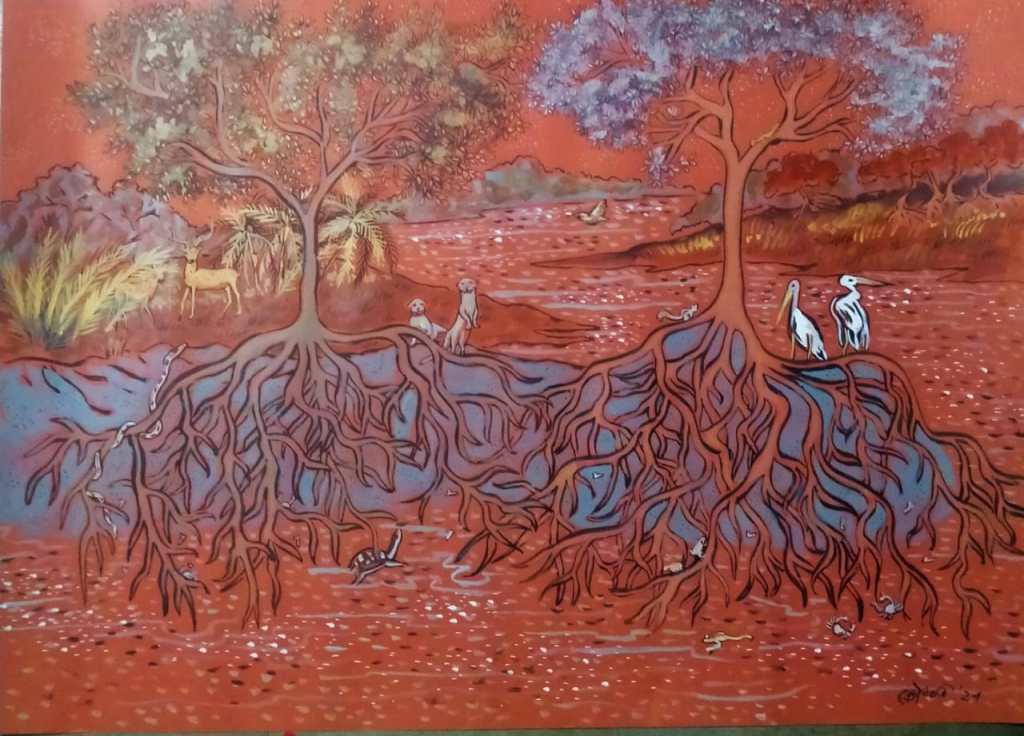
In Pic: Breathing Roots by Koustabh Chakraborty, Ecotone Exhibits

It is a naturally accepted proposition in art history and art-criticism that language, or words are always in an infinite relation with the painting. Words are sometimes rendered so imperfect that when they confront the visible realm of a painting, they are proven to be insuperably inadequate.

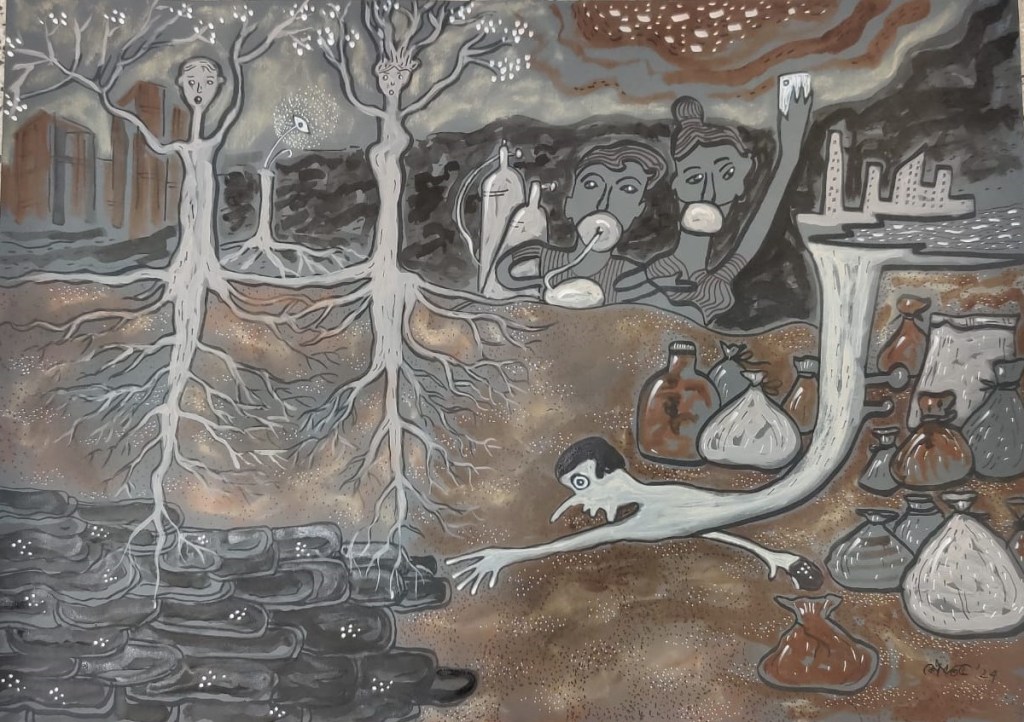
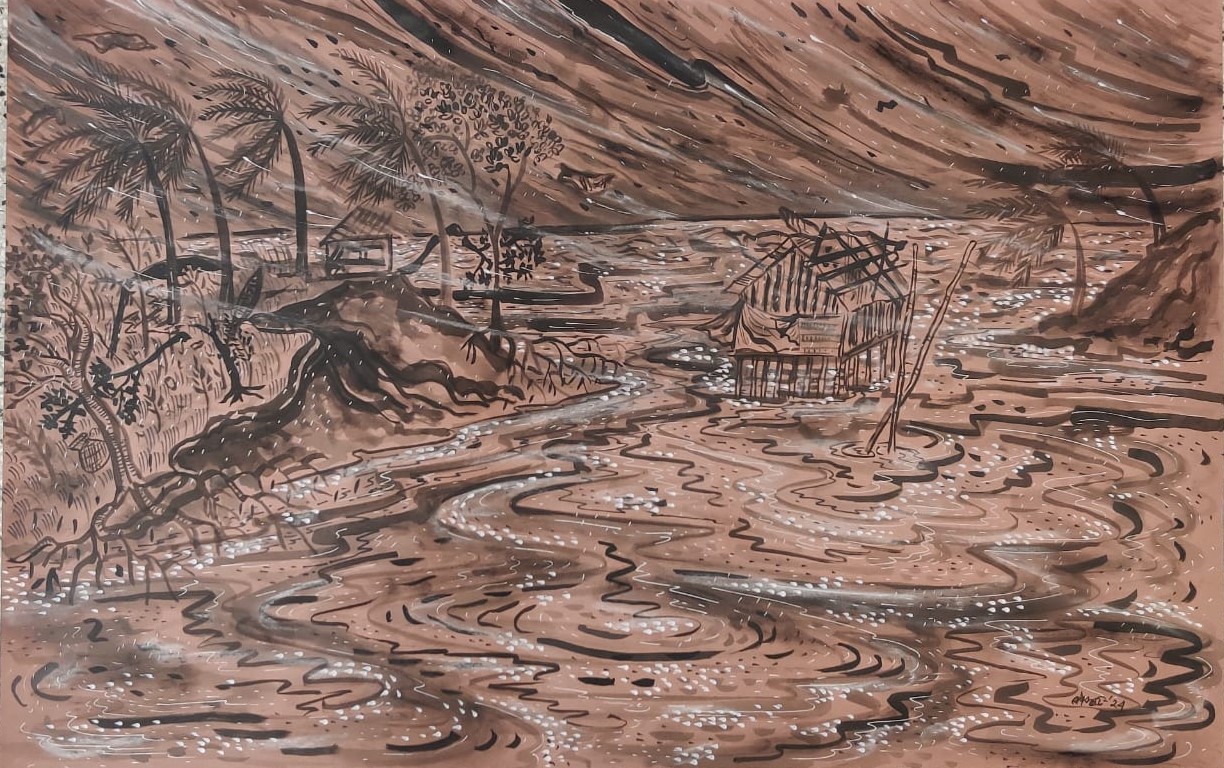
In this short meditation, however, I’m going to do such a task with the hope that language perhaps could do justice to the visual artist Koustabh Chakrabarty’s solo exhibition called ‘Ecotone’- a languid eco-political journey through the various different shades of brown, black, and grey and the monotonal ambit of sepia. Erected within the discourse of the Anthropocene, Chakrabarty’s painting here, in close conjunction with the ecological activisms of ‘Jaladarsha Collective’ weaves the epic confrontational relations between the ‘human species’ and the ‘Earth system’, beginning with creating the images of the “breathing roots” of Sundarban, to interpreting the disruptions in the ecosystem as “ecological injuries”. Chakrabarty as a humanitarian artist, collaborating with the eco-political commitments of the ‘Jaladarsha-Collective’, makes it possible to draw the images of torrential rain and storms afflicting the low-lands of Sunderban derived from images from his cognitive memory and collective activist praxis. If “Gluttonous Devouring of Lands” by a giant surrealist demonic creature suspended in space occupies Chakraborty’s poetic mind in one painting, then in another, the “harsh thorns in the mangrove forest” has symbolized the despotic signification of the patriarchal phallus. If one painting deploys Chakrabarty’s phantasmatic one-stroke-technique, then another has elucidated the rooting of life and labour of the marginal lands into the history of the modern ecosystem. Chakrabarty perhaps being driven by the collective’s eco-politics, believes that water doesn’t discriminate at all, and therefore draws the imagery of these “non-discriminatory flows” in a squiggly collection of arboreal roots deeply impregnated into the ‘Earth system’. So much so that in one painting, in order to sketch a different, lethal history of the Anthropocene, the eco-conscious Chakrabarty brings forth the images of the remnants of the industrial societies; inverted human faces suspended in the capitalist miasma; quasi-skeletal structures; the human-child, and a toxic spoon: putting all these things into one canvas, disrupting the conscious-rational syntax of human civilization; deliberately, albeit arduously trying to liberate the human-forms into an imaginary natural condition that is perhaps situated outside of the capitalist air of industrial society. The artist here politically rejects the songs of “birth and rejuvenation” and welcomes, instead, the “cycles of death and deterioration” so as to break with it.

The “conscience keeper”, in Chakrabarty’s artistic eye, or perhaps in his poetic mind, is scavenging for water and air. Thus, the artist is perhaps hell-bent not to let the newborn child grovel within this quagmire of toxic industrial waste as a part of human civilization which is regressing backwards. Quite on the contrary to these regressions, he conceives certain forms of human eye, or perhaps non-human, progressively appearing in history as the conscience of civilization. These are the same decrepit

In Pic: Conscience Keeper In A Brownfield Site, by Koustabh Chakrabarty, Ecotone Exhibits

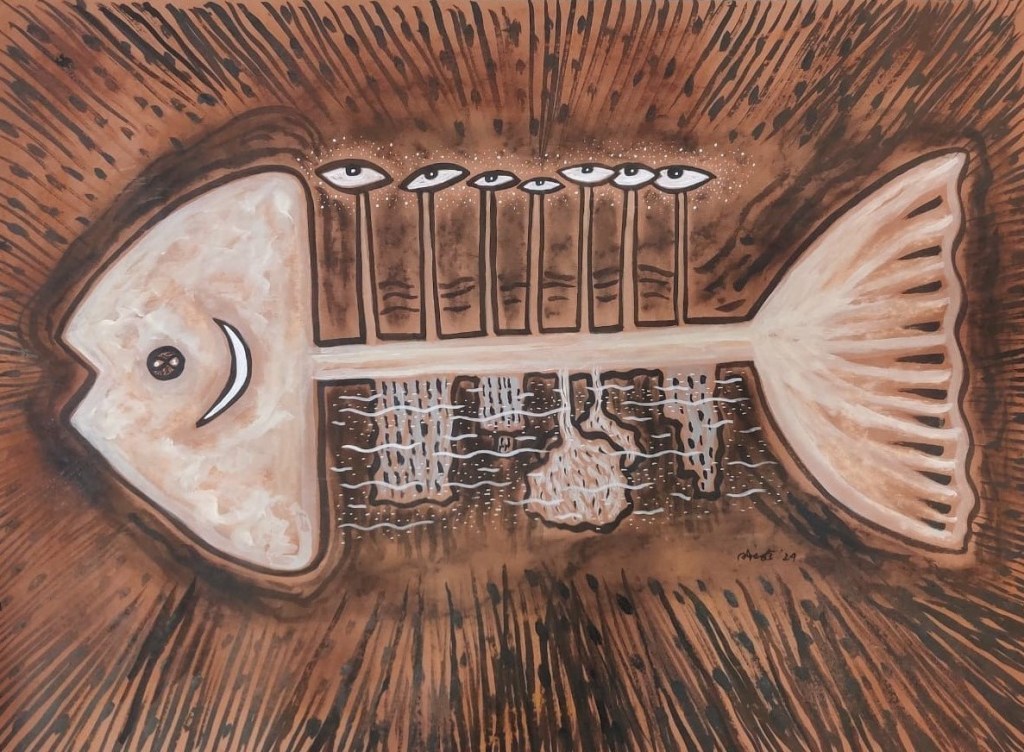
human eyes, in his next painting, which trans-mutate into a heap of garbage as if we have already failed humanity. But, gathering his mind steadfastly, Chakrabarty bucks up; and without letting the weary pessimism stagnate, declares in the final call that he dreams of having, an access to that imaginary ‘Fish Key’ that ceremonializes a moment within the sublime history of the Anthropocene; a moment when our individual human conscience will trans-valuate into a collective conscience, ultimately liberating life, labour, land and bodies from the imminent perils of extinction. It is as if Chakrabarty paints an anthropological fable of a series of human-environment interactions. But still “it is in vain that we say what we see; what we see never resides in what we say.”     

In Pic: The Fish Key, by Koustabh Chakrabarty, Ecotone Exhibits

Shirsho Basu belongs to the School of Cognitive Science, Jadavpur University, Kolkata, India

A Review of the Exhibition “Ecotone”

by Joshua Bodhinetra

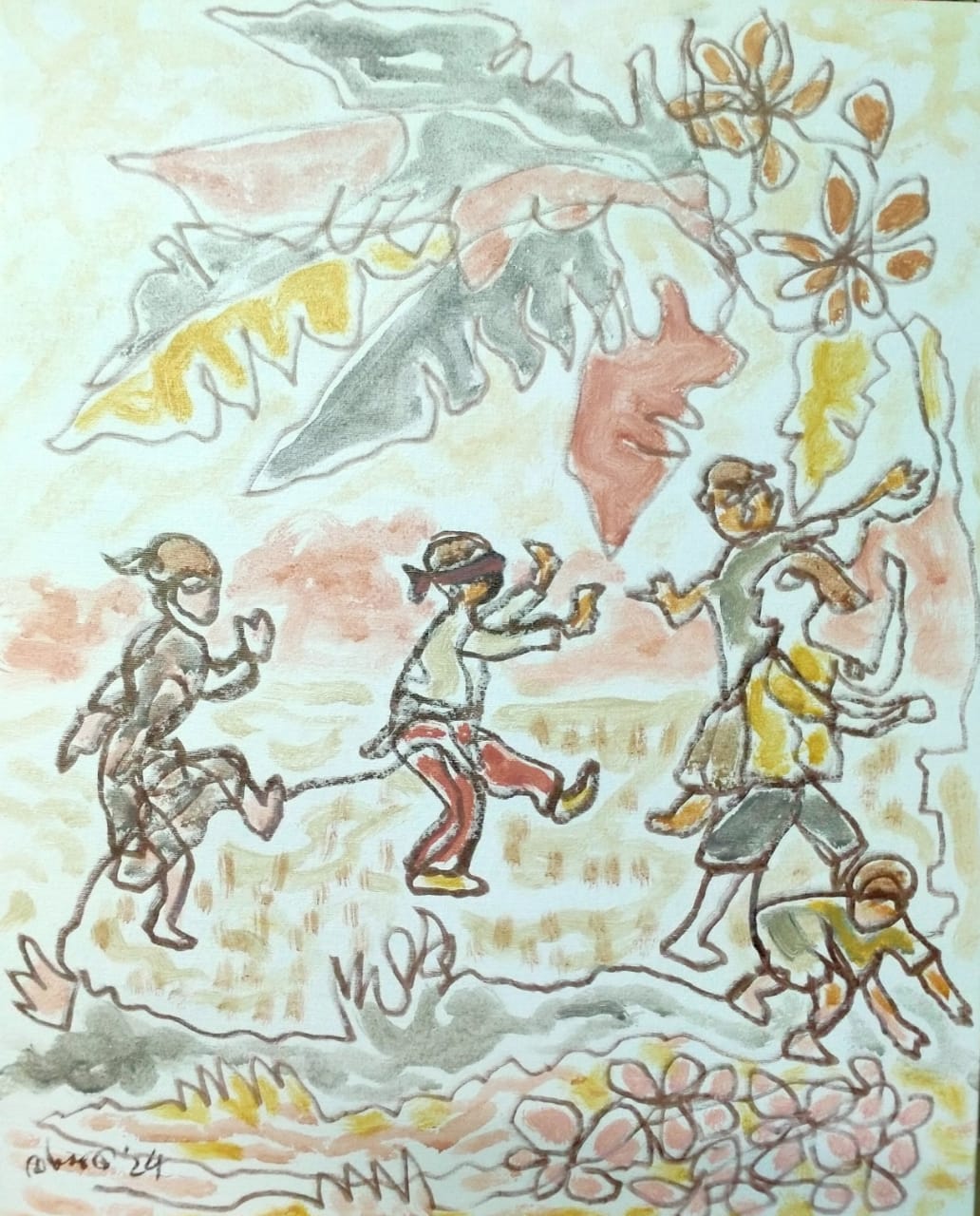
In Pic: Khelaghor, Embracing Play by Koustabh Chakrabarty, Ecotone Exhibits

Sabbe sattā, sabbe pāņā, sabbe bhūtā,
Sabbe puggalā, sabbe attabhāvapariyāpannā,
Sabbā itthiyo, sabbe purisā,
Sukhitā hantu…sukhitā hantu…sukhitā hantu…

(May all creatures, all life, all beings,
May all persons, all individuals,
May all women, all men,
Be happy…be happy…be happy…)

What happens when the liminal gets filled with the metaphysical? Does nature reclaim spacetime from humans, or do we subsume nature under our mechanised paradigm? Curiously, Koustabh Chakrabarty’s ECOTONE doesn’t ask these questions at all, rather he straightaway dives into the answer. Progressing from the playful to the tumultuous, from machines to mother-earth, this exhibition is guaranteed to leave everyone spellbound.

His brushstrokes challenge our linear understanding of co-existence, his palette outright rejects our unidimensional idea of ecosystems. He pledges neither a superficial harmony, nor some contrived nihilism. Koustabh, ergo our beloved Kosha-da employs multiple artistic genre to capture the exact moment when nature within collides with nature without. Through frolicking children, storm-lashed mangroves, sweat-soaked brick-kilns, poisoned mines and quantum entanglement of our collective anātman, he repeatedly creates a dissonant dream-lyricism seldom seen in contemporary art.

In Pic: The Cyclone by Koustabh Chakrabarty, Ecotone Exhibits

Nowadays, varied forms of eco-conscious fiction are on the rise. It is but a direct reaction to the ongoing climate crisis fuelled by runaway capitalism and majoritarian politics. Alienated childhood, climate refugees, labour crisis, resource-conflict, inequality and the loss of habitats are some of the broad themes that permeate through Kosha-da‘s paintings. Through the “has been” he shows us the “could be”, just like his “perhaps” glimpses into the “if only”. He consciously eschews bright colours, opting for an organic uniformity that resonates between the rust and the soot, the grey and the white. But, what does this muted exposition tell us? Is it our collective existential boredom, and a peek into the future? Does it talk about civilization’s eternal numbness, that nature fails to sooth? Or is it the Buddhist ideal of Majjhimāpaṭipadā that we, as a species, have grossly deviated from?

Even the leitmotifs of ECOTONE are spread across the essential triptych of the Middle Path — here water, playfulness and breath may seem to be at war with civilization, toxicity, and death, but in reality the entire spectrum is desperately held in balance by pixels, survival, and roots. And this, verily, is the ecohydrological pledge of Jaladarsha that strives to rescue us from our own greed.

An alumnus of Jadavpur University, Joshua Bodhinetra is a poet and writer currently working as the Content Manager, Indian Languages at the People’s Archive of Rural India (PARI).

, ,

A Tale of Struggle, Resilience, and Hope: Notes from the Seed Festival at Sundarbans

Ankita Bose


The mild chill descended on the morning of 16th February, 2024, when I, along with a few members of the Jaladarsha Collective, started out for the ‘Roots and Rights: Indigenous Seed Festival’, to be held at Gobindokathi & Patghora Netaji Maidan at Jogeshganj in Hingalganj block of Sunderbans in the North 24 Parganas district of West Bengal. I had volunteered to help out with the festival upon the request of my beloved friend, Aopala Banerjee, who works relentlessly for the conservation and revival of all things belonging to nature, community living, and bound by the invisible threads of love.

Being a student and ardent lover of literature, colours of romanticism seep through my veins. When I see blue, I am not reminded of royalty, instead my mind wanders to the myriad shades of blue that adorn the horizon; my mind travels to how the blue mixes with the green and the grey, to form the mirror-like surface of water bodies. With the heart of a romantic, and the zeal of a social activist, I ventured into the blue and the green of the Sunderbans with the purpose of aiding the local farmers’ struggle—one of the most relevant and significant struggle in contemporary India, given that a lot of farmers from the northern states of the country including Uttar Pradesh, Rajasthan, Gujarat, Haryana, have yet again collectively revived their dissent against the neo-liberal capitalistic farming practices that serves the ones in power, disregarding the interests of the ones who put in the labour and feed the people of the nation.

The scenes encountered during the boat ride from Dhamakhali Ghat to Jogeshganj Ghat displayed the cracks behind the romantic beauty of nature. The ghats were broken and dilapidated, making it a risky affair for people boarding the boats. The erosion of the river plains was apparent; however, the resilience of the local communities was also visible as most shores had cemented embankments surrounded with bamboo structures to prevent the river plains from eroding further. Few mangrove trees skirted some shores, although the numbers had declined from the last time that I had travelled to the Sunderbans, sometime in 2015.

Once we reached the hotel at Jogeshganj in the afternoon, we were quite tired, but all the team members were enthused with the spirit of the upcoming seed festival and quickly shed off their exhaustion to plunge into the pool of work that needed completion before the commencement of the festival. The remaining part of the afternoon and evening was spent in making posters and planning extensively for the exciting events of the next day.

The morning of February 17th brought with it the anticipation of meeting farmers from our land and exchanging knowledge across boundaries of caste, class, gender, and other imposed identities. Personally, I was excited about the coming together of human beings and sharing the know-hows of their realities and building a language that traverses the margins of our existence. For me, that is what constitutes literature—an amalgamation of thoughts beyond the various spaces and times that intersect to form our realities. The event was to be held from 11am to 4pm, a five-hour long celebration of the struggles of farmers in our land, the underrepresentation of women in the farming sector despite them having the most amount of contribution, and how art and literature are intricately woven into these narratives of labour and struggle.

As soon as the clock struck 10.30 am, farmers from different regions of the state started pouring in with their store of preserved seeds cultivated naturally without the use of chemical fertilizers and pesticides. I was surprised at how punctual these farmers were. While working in different sectors in the city, I have often encountered people taking time for granted; most are insensitive to others’ time, but here, in the village of Jogeshganj, the farmers understood the value of time and their passion was exhibited through the adherence of the schedule charted out for them.

The proceedings of the day began with the lighting of the auspicious lamp, an intrinsic part of rituals for any festival held in our country land. Thereafter, the co-founder of Jaladarsha Collective, Sayantoni Datta gave her introductory speech about flood-resistant environment-friendly seeds that have lost its relevance in the post-modern world. The most notable part of her impassioned speech, something that touched my heart, was when she shared her experience of travelling to the Sunderbans after the Amphan cyclone in 2020. She highlighted how the farmers gathered around where relief kits and aid was being given, and demanded flood resilient seeds instead, which would help them in the long-term.

Subsequently, a performance titled ‘Seed Energy’ by Madhyama Halder, a prolific dancer. In her performance, Madhyama exhibited the journey of a seed as it grows into a plant, with movements that portrayed how a seed nurtures itself, absorbs the nutrients from the soil, and then proudly springs up its head above the soil. She also highlighted the importance of preserving naturally farmed seeds, sharing knowledge about them, and the significance of community living among the farmers and rural people of the land through various movements and abhinaya. Her performance was highly emotive and resonated with the local people. It was followed by a group of local women singing Tushu gaan that portrayed the daily grinds of cultivating paddy, lentils, and vegetables in the lands owned by them or their family members.

Afterwards, two panel discussions were conducted that united academicians, researchers, and more significantly, the local women farmers who had grassroots knowledge about issues of agricultural practices, animal husbandry, and the benefits of natural farming. The first panel discussion that was held on the specificities of women’s role in agriculture recognised the mammoth participation of women farmers who are involved with agricultural labour. Chandra Mukhopadhyay, a researcher and archivist, who was a part of the panel, shared her experiences of intermingling with the farmers of Bengal, and collating the folk songs that speak of their toil and labour. Further, the other panelists shared their experiences of farming. The most significant factor that came up during the discussion was that of how women contributed to 80 percent of the labour required for farming, yet they are neglected and not given enough recognition in the national statistics and their representation is scarce, especially with regards to owning land and decision-making roles.  

The second panel discussion was held on climate-resilient farming practices wherein a plethora of people came together to discuss how agricultural produce could be increased with indigenous methods. In such a context, I would like to highlight my personal experience. I was stationed at the desk registering and documenting the farmers’ demands, along with another woman farmer assisting me. I indulged in an extensive conversation with my co-worker and learned a lot about the local problems in the region. She informed me about a particular variety of paddy known as Radhakathi that can survive floods and the high salt content of the water typical to the region. In tandem with her narrative, the second panel discussion highlighted the importance of seeds cultivated through natural processes, ignoring the lure of commercially cultivated crops. Most of the panelists emphasized that locally and naturally farmed seeds are more climate resilient, salt tolerant, and flood resistant than the High Yielding Variety (HYV) seeds promoted by the corporate machineries. The farmers particularly stressed upon how naturally farmed seeds are the only seeds that can grow to a height of 4-7 feet while the other HYV seeds are unable to meet such standards of cultivation, especially when it comes to floods which are common to the area. Additionally, women’s participation in agriculture was celebrated and prominence was given to how they must be given their due respect in terms of land ownership and decision-making. 

The events for the day also comprised kids coming together to exhibit performances encouraging communal harmony, and various farmers sharing their knowledge and experiences of cultivating seeds produced through natural means.

Two small discussions were held on the nitty-gritties of goat rearing and fish farming that witnessed the enthusiastic participation of the audience. In accordance with the local demands of the people, these concentrated discussions on animal husbandry provided the local people with the know-hows of goat rearing and fish cultivation, both of which are important and profitable means of livelihood for the people of Sunderbans.

Finally, the best was saved for the last. A group of local women farmers came together to present a performance that juxtaposed dance, songs, and theatre in tandem with the movement of the Theatre of the Oppressed started by Brazilian theatre practitioner, Augusto Boal, in the 1970s. Beginning with a tribal kathi dance, indigenous to the tribal community of the region, they later delved into matters of prime importance. The message of their performance was loud and clear: they narrativized the entire episode of the Green Revolution in the 1960s and how thereafter, the farmers were lured into using HYV seeds that instead of increasing their production and cutting down their costs, did exactly the opposite. The neo-liberal practices increased their costs as the farmers now had to buy chemical fertilizers and pesticides to keep their produce from rotting. Eventually, the greed for social mobility resulted in the farmers incurring huge losses and some of them resorting to commit suicide in order to escape debts. The performance resounded with one and all in the audience and brought waves of empathy and left many rolling in tears .

At the desk designated for collecting farmers’ demands and complaints, many came up sharing their anecdotes of how there isn’t enough mechanism to drain out excess water during floods, which is why a lot of their crops are damaged. They said that despite reiterating their demands for a proper drainage system, the government has done little to fulfil their demands.

All in all, this experience of volunteering at the seed festival nourished the seed of my soul, the one that had laid dormant and thirsty for tangible social change. When I saw the farmers devotedly propelling natural farming practices, something told me that all’s not lost to the greed of power and money. On my way back, the soothing boat ride that embraced my being with the blanket of fog, reminded me of lines that I had read written by a social activist from a land as far as Uruguay. Eduardo Galeano had written in his book Open Veins of Latin America, “It’s worthwhile to die for things without which it’s not worthwhile to live.” Indeed, it is. The farmers from my own land showed me that the path for social change intersects the values of hope, struggle, and resilience. When the boat lost its way in the foggy shadows of the morning, all fear evaded us. We were content that we had contributed to the struggle of life and death that the farmers of our land continually engage in, day in and day out, only to feed the billions in our country. For them, fighting for their life’s sustenance dissolves all fear of death, and that was the spirit upheld by the seed festival.    

Ankita Bose is a writer, translator, poet, and dreamer. She holds a MA in Comparative Literature from Jadavpur University and a BA in Sociology from Presidency University

‘চক্ষু-চড়কগাছ’!

‘চক্ষু-চড়কগাছ’! ~ শাশ্বত লাহিড়ী

বাংলার একটি অতিপ্রাচীন প্রবাদ।
কোনো ঘটনায় বিস্মিত মানুষের চোখ-কপালে ওঠানো ভঙ্গী বোঝাতে বাংলায় যা যুগযুগান্ত ধরে চলে আসছে। আজ চৈত্র-সংক্রান্তি, চড়কপূজা। লোকমুখে ‘শিবের-গাজন’ বলে পরিচিত। এই পূজার সাথে তথাকথিত ব্রাহ্মণ্যবাদের চেয়েও বাংলার লোকাচার জড়িত থাকায় এতে সরাসরিভাবে সব স্তরের মানুষের অংশগ্রহণ অনেক বেশি চোখে পড়ে। পুরাণ অনুসারে, শিবের উপাসক ‘বাণ রাজা’ আজকের দিন শ্রীকৃষ্ণের সাথে যুদ্ধে ক্ষতবিক্ষত হয়ে শেষে অমরত্ব লাভের আশায় নিজের রক্তাক্ত শরীর নিয়ে নৃত্যগীতের মাধ্যমে শিব’কে তুষ্ট করে নিজের অভীষ্ট সিদ্ধ করেন, সেই স্মৃতি’তে শৈব সম্প্রদায় চৈত্রের শেষ দিনে এই বিশেষ প্রথা পালন করে। এই পূজার সাথে বিভিন্ন অদ্ভুত, বিচিত্র কিছু খেলা জড়িত যা প্রকারান্তরে পূজার মূল আচার হিসাবে পরিচিত। পূজার আগের দিন, চড়কগাছের লম্বা তক্তাটিকে সিঁদুরলিপ্ত করে রাখা হয়, যাকে ‘শিবের পাটা’ বা ‘বুড়োশিব’ বলা হয়। এই গাছটিকে কেন্দ্র করেই বিভিন্ন খেলা, বা শারীরিক কসরৎ অনুশীলন করাই এই পূজার মূল উপাচার যেমন, জ্বলন্ত অঙ্গারে হাঁটা, বাণফোঁড়া, শিবের বিয়ে, বঁটিঝাঁপ, ঝুলঝাঁপ, কাঁটাঝাঁপ, অগ্নিনৃত্য, চড়কগাছে দোলা ইত্যাদি উল্লেখযোগ্য।
রাতে, শিবের উদ্দেশ্যে খিচুড়ি ও শোলমাছ দিয়ে ‘হাজরা-পূজা’ করা হয়। ১৮৬৩ সালে ব্রিটিশ সরকার এই পূজার ভয়ানক অনুশীলন রীতির কারণে আইন করে এই পূজা নিষিদ্ধ করলেও, আজ অবধি দুই বাংলার বহু প্রাচীন শিবের থানে এই পূজা মহা সাড়ম্বরে পালিত হয় আজকের দিনে…

বেহালা_চড়কতলা এমনই একটি শতাব্দীপ্রাচীন দেবালয় তথা জনপদ।
আমরা ঘুরতে ঘুরতে যখন চড়কতলায় পৌঁছাই, সেখানে গিয়েই লক্ষ্য করি এই স্থানের প্রাচীনত্ব, তার ঐতিহাসিক গুরুত্ব। বিশাল বটগাছের নিচে বাংলার লোকদেবতা পঞ্চানন মন্দির সংলগ্ন যে পুকুর, তা আজ কচুরিপানায় ভরা এক ডোবায় পরিণত। তার পাশে দাঁড়িয়েই এক প্রৌঢ়া আমাদের বলেন, এটি পারিবারিক পুকুর হলেও একসময় এই পুকুরের প্রচুর ঘাট ছিল, এখানেই একসময় বাঁধা হত বিশাল চড়কগাছ। এছাড়াও, ছোটবেলার স্মৃতি থেকে উঠে আসে কালীঘাটে’র স্বনামধন্য নকুলেশ্বর-তলা’য় ঝাঁপ, ধুনো পোড়ানো, মেলা ইতিহাস-প্রসিদ্ধ। সারা কলকাতা’র একসময় এমনই সব বিখ্যাত গাজনের চল ছিল, যা দেখে সত্যি’ই এককালে লোকে’র চক্ষু চড়কগাছ হতো।

বেহালা চড়কতলার সন্ধান আমরা পেয়েছিলাম আমাদের ওয়াটারবডি সার্ভে করতে গিয়ে বেহালার ১২১ নম্বর ওয়ার্ডে।এই পুকুরে একসময় চড়কের সময় বিশাল বড় বড় গাছ বাঁধা হতো। বাংলার বিভিন্ন জেলার প্রত্যন্ত গ্রাম থেকে ভবঘুরে সন্ন্যাসীরা সপ্তাহখানেক আগে থেকে এসে বাসা করতো এই চড়কতলায়। এই পুকুরে বাঁধা বিশাল গাছে চড়কের প্রসিদ্ধ ঝাঁপ, বিভিন্ন ভয়ানক খেলা প্রদর্শনী চলতো। এই পুকুরের স্বচ্ছ জলেই পুজোর রান্না থেকে বাকি সব আচার অনুষ্ঠান চলতো। যুগের সাথে সাথে মেলার আকার আয়তন কমে আসলেও আজ থেকে তিন চার দশক আগে পর্যন্ত পুকুরের জল বেশ স্বচ্ছ এবং এলাকাবাসীর সব নিত্যপ্রয়োজনীয় কাজে ব্যবহার হতো। যখনও পর্যন্ত আমাদের জীবন তার বিষ বাতাসে ঘিরে ফেলেনি প্লাস্টিক দস্যু।

তারপর ক্রমে পুকুরের মূল মালিকের থেকে দু বার হাতবদল হতে হতে আজ এই ঐতিহাসিক ঐতিহ্যবাহী পুকুর পরিণত হয়েছে পানায় ঘেরা ডোবায়।এখন চড়কতলা মন্দির সেই এক জায়গায় থাকলেও আর এই পুকুরের চরম অপরিষ্কার দূষিত জল কোনো কাজে লাগে না পুজোর। পুরসভা দায়সারা ব্লিচিং পাউডার ছড়িয়ে, নির্দেশিকা বোর্ড টাঙিয়ে গেলেও লোকজনের তাতে বিন্দুমাত্র ভ্রুক্ষেপ নেই।


বহু পুরোনো স্থানীয় মানুষের আক্ষেপ যে এখনও আছে তাদের এই পুণ্য জলাশয়ে’র মৃতপ্রায় অবস্থায়। আমরা সার্ভে করতে গিয়ে একজনকে প্রশ্ন করতে গেলেই চারপাশের বাড়ি থেকে পুকুরের মূল মালিকের বংশের প্রতিনিধি ষাটোর্ধ্ব প্রবীণ বেরিয়ে আসেন অতি উৎসাহী মুখে। তাঁর মুখেই শুনি তাদের থেকে বিক্রি হবার পর আবারও বিক্রি হবার পর সেই নতুন মালিকের হাতে এই জলাশয় বিক্রি করে নতুন নির্মাণ করার খবর শুনে চিন্তিত হয়ে তিনি যখন পুরসভা মারফত মেয়রে’র সাথে যোগাযোগ করে তাকে এলাকায় আসতে বলেন, তখন এলাকার প্রভাবশালী’দের মদতে কিভাবে পুরসভাকে আসতে দিতে বাধা দেয় সেই কাহিনী শোনা। হতাশ মুখে তিনি আমাদের দেখে বলেন, আপনারা সবাই চেষ্টা করে দেখুন না আমাদের এই স্মৃতিবিজড়িত পুকুরকে যদি এই উন্নয়নের হত্যা থেকে বাঁচানো যায়!

আমরা তাকে সেভাবে কোনো আশ্বাস দিতে না পারলেও, যদি আমরা এই শহরের সব সচেতন মানুষ একটু একটু করে এগিয়ে এসে নিজেদের এলাকার প্রাচীন ঐতিহ্য বাঁচিয়ে তুলে প্রকৃতি’র সহজাত স্বাভাবিক ভারসাম্য রক্ষা করতে পারি, তবেই হয়তো আগামীদিনে জলাশয়ের সাথে সাথে তলিয়ে যাবার হাত থেকে রক্ষা পাবে আমার আপনার আমাদের সবার ভালোবাসার শহর।

প্রশ্ন রইলো। একটু ভেবে দেখার।

Mangrove Restoration lessons for and from Sinthilya village, North 24 Parganas

Radhika Bhargava

Sinthilya village is located near the India-Bangladesh border towards the north of Sundarbans mangrove forests’ core areas. It is a village that replicates and lives with every love problem of the Sundarbans – tiger attacks, erosion, flooding, single crop lands, saltwater intrusion and cyclone damage. Evidently the area is poverty ridden and the population is dealing with numerous issues to survive.

However, with the combined efforts of the locals and Jaladarsh collective some significant solutions are being implemented.  One such solution is of mangrove restoration. The purpose of the restoration project undertaken by the Jaladarsh collective is not only to promote green spaces but to also restore the shoreline and provide alternative livelihood options. It is an invest for the sustainable future of the village.  The eastern area of Sithalia has multiple mangrove restoration beds. Some of these are undertaken by the local government who is taking care of naturally accreting and naturally restored lands, and Jaladarsh is contributing by converting other eroding wastelands into mangrove beds.

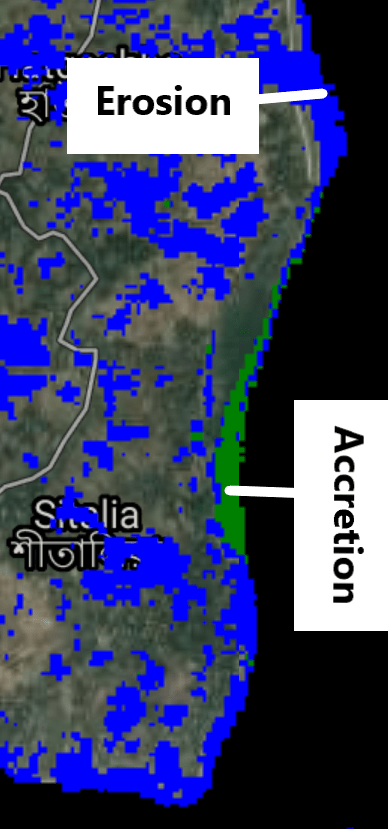
Erosion is one of the most prevalent issues in the region and it exacerbates the impacts of other stressors in the region. One of the direct impacts of erosion is loss of land which leads to migration of people and loss of biodiversity. Eroding lands also act as a foreground for extreme losses that can abruptly take place overnight. In the Indian Sundarbans, the total amount of erosion has been 136 km2  over the past 35 years. In Sinthilya, erosion is taking place on the eastern side (Fig 1.)

Fig 1. Erosion (Blue), Accretion(Green) over the past 35 years in Sundarbans.

A question that often arises with mangrove plantation, one that we discussed with the local community on Jaladarsha Collective’s field trip to Sinthilya in March was – is it better to plant mangroves on accreting land or on eroding land?

While planting mangroves on an accreting land is promising as the land will keep growing and the newly planted mangroves will help in holding on to the soil, the downside is that the land or that area is preferred for land growth so mangroves might naturally settle and grow there. So, it might make sense to promote mangrove growth in the eroding areas. Eroding land is prone to further erosion, if there are no mangroves growing in that area, it might get eroded very quickly. If mangroves are grown in such areas, they will hold on to whatever land is remaining and with other intervention erosion can be prevented. If a land start eroding once, it will keep eroding unless the force is disturbed or distributed. With mangrove plantations and some bamboo, brick, and wired structures such disturbance and distribution of force can be achieved.

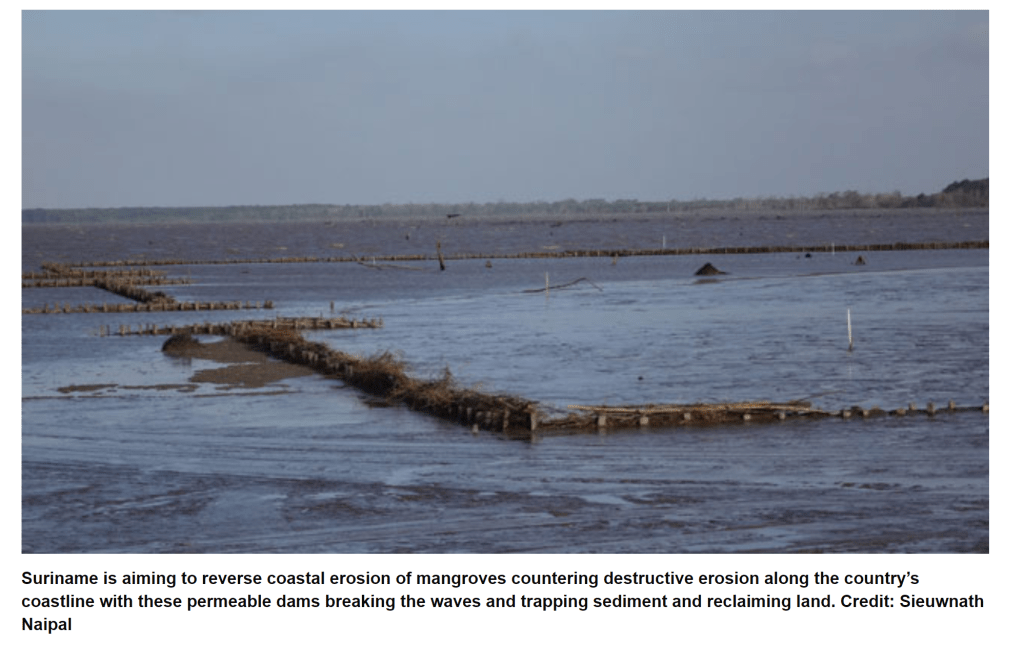
The beds where Jaladarsha Collective has planted mangroves is on the eroding beds. The plantations have successfully survived for _ months. It is promising that the plantations would develop into healthy mangrove beds. But a sign of worry is the eroding shape of the shoreline. When the shoreline is curved like a ‘c’ shape, the impact waves that hit the surface is increased which causes additional erosion. The collective can investigate nature based solutions1 (like permeable dams made of wood, bamboo, brush) to somewhat weaken the waves that hit the shoreline. With a caveat that they are properly monitored for the long term and any side effects are remedied. Therefore, with reduced wave energy and increased support from successfully growing mangroves the stability of a historically eroding bed can be promoted.

Another key lesson from the plantation initiatives of the collective is promoting the growth of mangrove predecessor species like dhani grass (Aeluropus lagopoids) and Sea Holly (Acanthus sp.). These species were growing along with mangroves on their planted beds. These species aid in bed formation that will eventually promote mangrove habitation. Along with these species, various crustaceans (shrimp, crabs) and other mangrove associated flora and fauna are also needed to create a healthy environment to promote mangrove health on plantation beds.

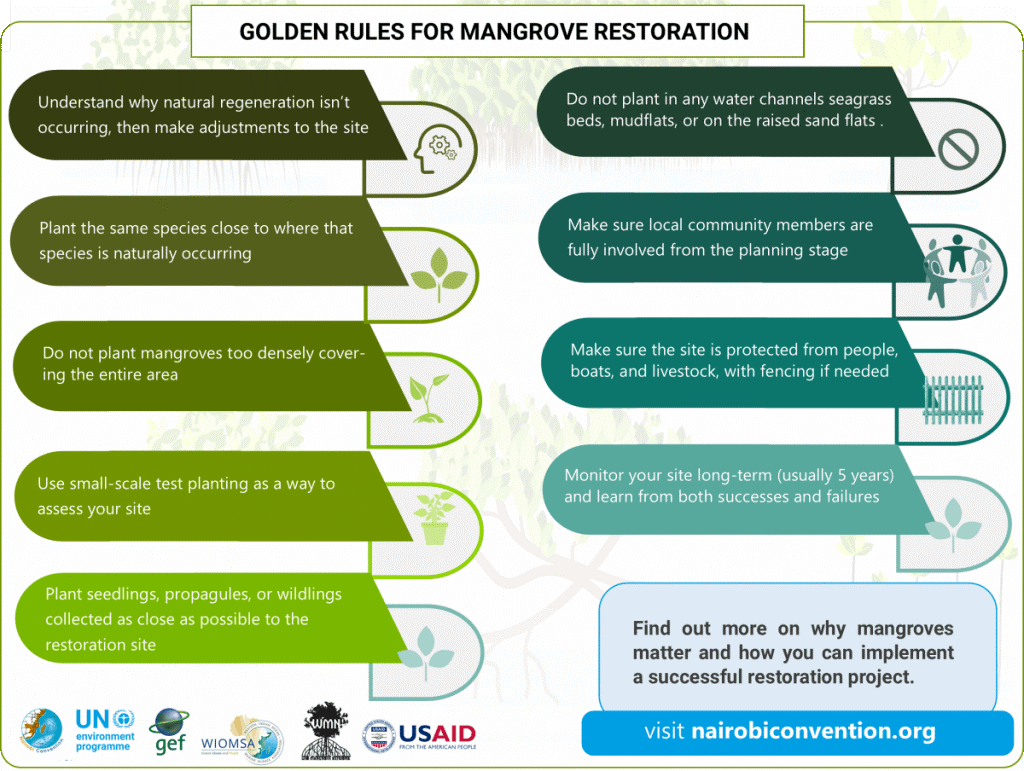
One problem that is yet to be resolved is the issue of goats eating and disturbing newly planted mangrove beds. The goats in the Sundarbans have developed affinity for salty and muddy mangroves! So, during summer when there is not as many green spaces around, they prefer to munch on mangroves. In some areas fencing can be done but sometimes the goats won’t even spare the bamboo fencing. Villagers try to be vigilant of goats, but it is not the most proactive solution. One way would be to give feed to the goats so that they don’t have to go to mangroves or may be psychological training can help as a long-term solution. Finally, some of the basic things every mangrove plantation initiative should consider before, during and after plantation is done are outlined in the infographic below.

References:

  1. https://doi.org/10.1016/j.ecss.2020.106798
  2. https://www.conservation.org/blog/new-science-restoring-forests-coastal-protection-and-more?utm_campaign=General&utm_medium=social&utm_source=twitter&s_src=twitter&s_subsrc=General_2021Jul26

About the Author:
Radhika Bhargava is a coastal scientist who specializes in large-scale ecosystem processes and threats. She uses geospatial analysis and social sciences to understand how transboundary ecosystems can be co-managed with the community. Currently she is working on the transboundary governance of the Sundarbans for her PhD thesis at the National University of Singapore in the Mangrove Lab and as a National Geographic Explorer.

Non Biodegradable Polyvinyl debris accumulating in the Sundarbans

The need of the hour is to repurpose and reassign our thoughts to save the land from further degradation.

Chaiti Nath

Since the Amphan had hit along with the raging pandemic, and the very recent Yash cyclone, the Sundarbans have been receiving a considerable amount of assistance from various quarters. The ongoing donation drives, and health camps by generous individuals, NGOs, and philanthropic institutions have concentrated around these fragile embankments and the perilous fronts of the delta. However, even if each of these initiatives is a commendable gesture, the need of the hour is to repurpose and reassign our thoughts to save the land from further degradation.

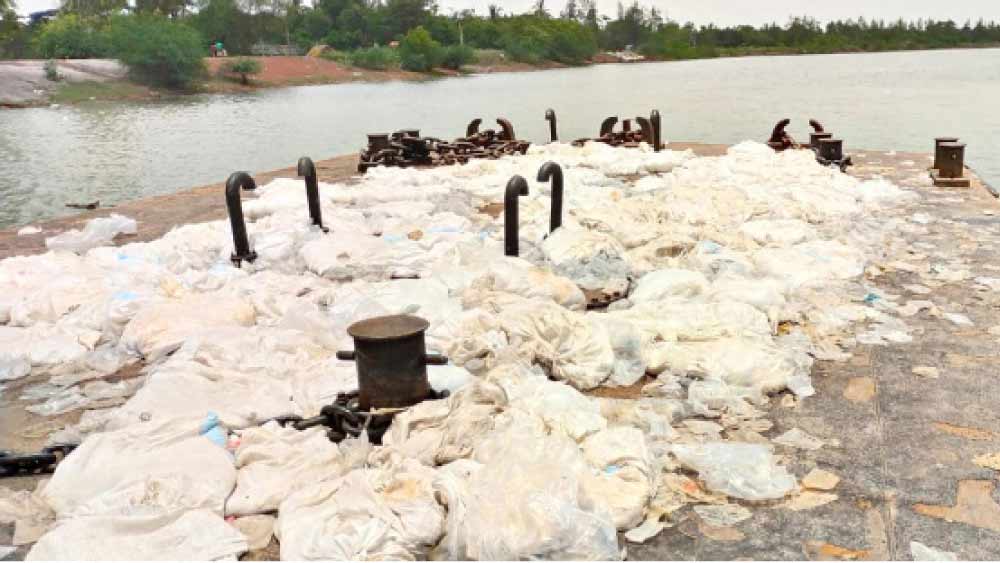
We shall begin this conversation with a simple statistical report retrieved from Ananda Bazar Patrika, dated 12th June 2021. It asserts that each day around 5 donation drive collectives reached Hingalganj as reported by the Rupmari Panchayat to serve at least 400 to 500 vulnerable families. Most of the time, the packages arrived in polythene bags which means each week no less than 14,000 polythene bags were being discarded. This count gives us an idea about the situation in the delta shores where the interest of the donation initiatives operates at its peak.

The role of local administration is converse in this case. They are trying to cease the accumulation of plastic wastes in many areas along with spreading awareness on using alternative packaging. In some places there are instances where complaints are being raised owing to the accrual of plastic pouches containing drinking water distributed by the administration itself.  There is no doubt that the misfortunate that the population in Sundarbans is facing is tragic and philanthropic advances are needed. However, it is time to rethink the medium of aid distribution to save the marginalized from yet another ecological disaster.

The mangrove is anyway exposed to the harshest natural calamities, afforestation, and steady land erosion that are directly affecting the residents. In addition, channels of waste from Kolkata flow into the Sundarbans every year, and often plastics deposit themselves on the mangroves choking them.

These polybags have already pervaded the entire area; the bags transport themselves along with the flowing water and choke channels and river beds. The aquatic life in these waters are jeopardized. It is high time that we realize that delivering donation aids in polybags to the Sundarbans is equivalent to injecting venom into our entire organic system.

Drinking Water Packaging leftovers at Gosaba. Courtesy: Ananda Bazar Patrika.

The mangrove is anyway exposed to the harshest natural calamities, afforestation, and steady land erosion that are directly affecting the residents. In addition, channels of waste from Kolkata flow into the Sundarbans every year, and often plastics deposit themselves on the mangroves choking them. Innocent lives are now forced to become communities of ‘Climate refugees’ or  ‘Environmental migrants’ shifting their base every year. It is great to acknowledge our privilege to be able to stand by them but we can never wear their jaded feet walking in search of a new settlement. Perhaps we are not designed to handle that sort of anxiety. The only way we can help them out is by discerning the crux of the situation. Therefore, Jaladarsha Collective has been reflecting and rethinking itself and urges you to rethink as well. Can we find alternative ways of helping this population sustain and survive, the first step being the packaging solutions around relief so there is no collateral damage.

As an alternative, you can pack your aids in paper or cloth bags glued or stitched out of scrap materials. Give it a little thought, how about aid packages that will be purposeful for future uses?

Next time you travel to Sunderbans to stand beside the residents in these adverse situations, please make it a point to make use of sustainable packaging options. As an alternative, you can pack your aids in paper or cloth bags glued or stitched out of scrap materials. Give it a little thought, how about aid packages that will be purposeful for future uses? Hosting bag-making workshops might also be a solution to provide a few bucks for the economically poor. We too in the past have distributed aids in the Sundarbans area during Amphan wreaked havoc in 2020 in plastic packages and have immediately paused operation once we realized the vicious consequence. We hereby pledge to take accountable initiatives and we hope you all do too. Let us address and solve the broader reluctance to engage, to assert responsibility to commit.

Panchayat in Gosaba has heralded a unique system of exchanging currency against the deposit of polythene in their recycling bank.

“গোসাবায় প্লাষ্টিক ফেরালেই টাকা” – এই সময় দৈনিকের প্রতিবেদন | Dated: 22/06/2021

Will conclude this entry with two positive stories. The Gosaba block within the Satjelia gram panchayat had already begun reforms to cease the use of polybags around January 2020. The local administration runs regular awareness campaigns to broadcast the ill impact of polybags and the locals have taken it in their stride. Sounds good. Another optimistic story is the same panchayat in Gosaba has heralded a unique system of exchanging currency against the deposit of polythene in their recycling bank. Guess what, the people are optimistically responding to it!


References:
1. মারাত্মক প্রভাব পড়ছে বাস্তুতন্ত্রে, দাবি পরিবেশবিদদের – ত্রাণ সামগ্রীর প্লাস্টিকে ভরছে সুন্দরবন
https://www.anandabazar.com/west-bengal/24-parganas/sunderbans-filled-with-plastics-after-relief-materials-provided-to-the-victims-of-cyclone-yaas/cid/1286473

2. সুন্দরবনে প্রথম প্লাস্টিক মুক্ত হতে চলেছে সাতজেলিয়া গ্রাম পঞ্চায়েত
https://eisamay.indiatimes.com/west-bengal-news/kolkata-news/seen-sattelia-village-panchayat-is-going-to-be-the-first-plastic-free-in-the-sundarbans/articleshow/73192330.cms

3. “গোসাবায় প্লাষ্টিক ফেরালেই টাকা” – এই সময় দৈনিকের প্রতিবেদন | Dated: 22/06/2021

Design a site like this with WordPress.com
Get started