Young Rural Women’s Leadership Building Programme


JULY 1ST 2021 – 10 Selected Participants.

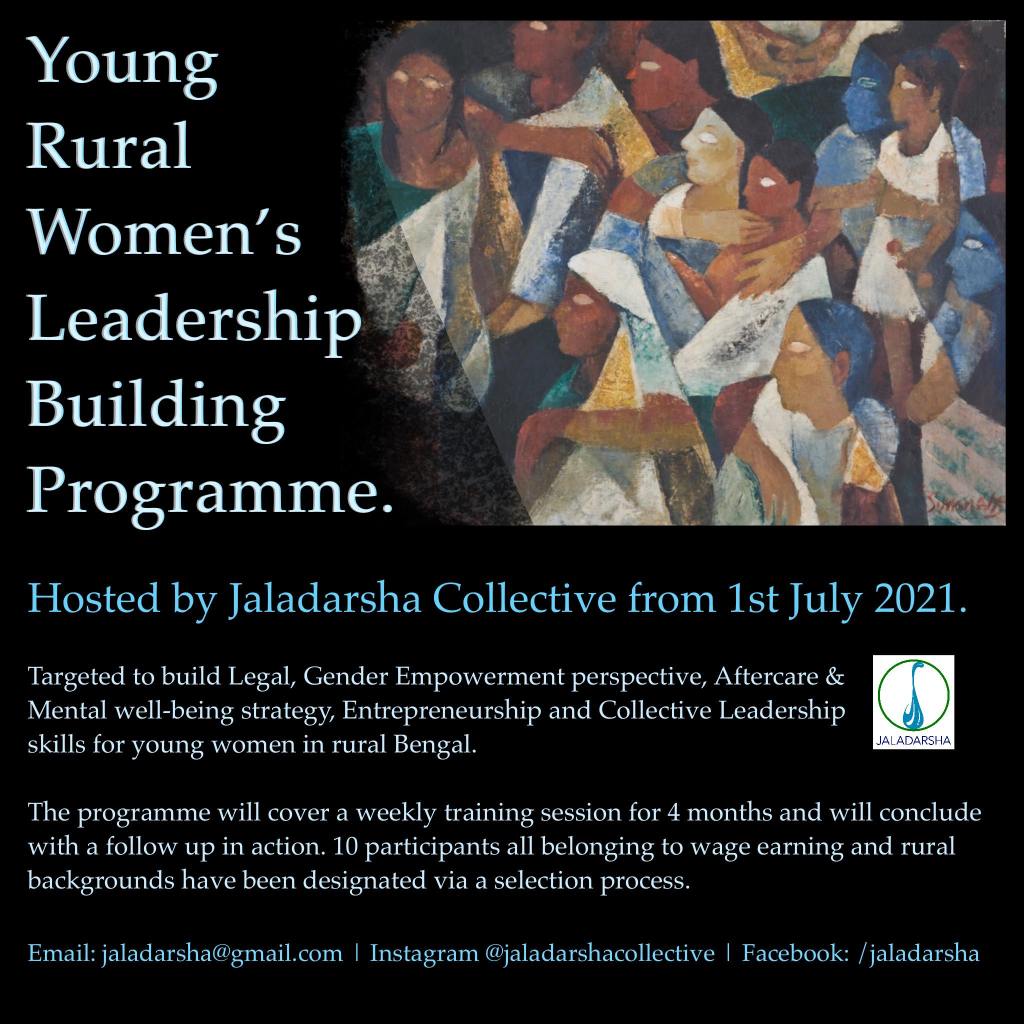
Image Courtesy: Somnath Hore, Oil on Canvas, 1950

Jaladarsha Collective has started a 4-month long programme to build Legal, Gender Empowerment perspective, Aftercare & Mental well-being strategies Entrepreneurship, and Collective Leadership capabilities for 10 young women in rural Bengal.

The YRWLB programme will cover a weekly training session for 4 months and conclude with follow-up action. The participants belonging to wage-earning and rural backgrounds have been designated via a selection procedure. Hoping that the training will help young women to focus on their own lives, learn to make independent decisions, build support groups for young women in their area and identify opportunities to work on their initiatives.

Let’s build resilience!

The Aroma Exercise

The Surprises in the Aroma Exercise

Sayantoni Dutta

We got a short time between the first and second wave of COVID lockdowns to physically visit communities and interact with the women’s groups being formed by our  young leaders Sarifa and Roshenara in the village. The idea of bringing these groups together was to create supportive communities, and hold well-being workshops.

In one such short visit, to Dwarkanda, we began a discussion with women, on what their needs were, how they were managing their lives and discussing our well-being.

Getting conscious of our senses and what it does for us.

‘Touch’ has become a controversial sensory experience for women and men, post the pandemic. For women, those from backward castes, ‘touch’ has always been controversial. In the same way ‘smell’ too is an important sense for us. The new young recruits into Jaladarsha Collective had just finished a course on permaculture at, a place ironically called “The Smell of the Earth”. Since then, we kept asking each other about ‘smell’ and ‘smells’. Smells can be very unique sensorial experiences, and not always liked by each and everyone, smells are also closely related to memories and experiences. I had no idea that a very simple exercise on smells could actually unleash such a vast amount of information and experience from among the women. 

The Exercise

The instructions for the exercise was simple. We divided the larger group of women into smaller groups of five, and we asked each of them to look for their favourite smells. They could then share with us a memory or why they loved the smells. Women went out of the room and walked far and wide around the area where the sessions were being held and came back with all kinds of leaves, barks, flowers with them. Essentially most of what they had got was from the natural surroundings. No perfumes, no cosmetics, nothing artificial.

The surprises

I was surprised to find the rich biodiversity in the village. Not a single person had brought a leaf or flower that was the same as the other person. To list a few varieties, there were mango leaves, leaves of different fruit trees(lime, lichee, pummelo, woodapple, papaya, pulses) and barks of trees, hay, soil and flowers.

The aroma exercise also helped to bring forth a lot of discussions on food and their childhood. Some spoke of their memories of childhood and some of a tree that they would find solace under. Not only did women discuss this, but the process helped to break the ‘taboo’ on discussions on food and what we liked to eat or did not eat.The group also crossed a religious barrier. Women from the Muslim community started discussing their favourite ‘beef’ preparations. Some of the Hindu women spoke about the leaf of the bel tree and its place in rituals. Through the exchange there was a cultural exchange of food and religious customs between the women from different communities and coming to a better understanding of each other’s and the communities we belonged to. Many of them were able to look at these objects, as something that helped them heal. 

Did you know that the Pummello leaf has the most beautiful smell? 

It works well for an uneasy stomach.

That lime leaves put in curries and the bay leaf and Elaichi.

Are  women’s favorite aromas for a festive family meal.

That while we like the Himsagar fruit, its leaves smell good too.

And the neem, tulsi and Bel tree.

Act as air fresheners around our houses

That the leaves of the marigold, like its flower

And of the lime and lichu, like its fruit 

Also smell good

And surprisingly the ‘Arhar’ flower which we never get to see

But it’s seeds we eat, is special

And like this are the other parts of a plant 

that might give us joy, if we bothered to see them

And along with this, the smell of soil

And freshly cut hay

Carry memories of a fertile land, and fresh harvests

And to this do, add

Lime, neem, tulsi, turmeric, 

And you have a garden of everyday medicine.

Daharkanda

Green fields, grazing animals, lush greenery, and simple people with utmost hopes in their hearts unaware of what is happening in the world outside. What else comes to our minds when we think about a village? Daharkanda almost fits this bill, from our childhood tales, but reality is always stranger and harsher than fiction.

My recent stay in this village has given me rich insight into the concerns it faces, especially recent, and possibilities to mitigate them over time, through proper intervention and awareness programmes. Bringing change takes a lot of time and perseverance, and we need to be more accepting towards their way of life, which though harsher, is in sync with nature. We must never break that. I had previously visited the village for workshop purposes, but staying in their houses, and accompanying them in their daily chores, has allowed me a clearer understanding of the village practices. One cannot understand the dynamics of a place, or the people inhabiting it, until one experiences their lives in their ways. Visiting a place for half a day doesn’t let them open up to you as much as it is needed for us city dwellers to understand their lives & livelihood, either. A writeup is not possible to elucidate our findings and realizations that we have come across in our visit, but as researchers it is our duty to give a sneak peek into their lives through us so that we understand that a life without exploiting the environment is possible and cost-efficient.

You will mostly find everything you need at your doorstep without having to make a call to the online grocery stores. And most of it is free! From firewood for cooking to mud for building houses and stoves, and even water snails to feed ducks with.

As I write this, the whole world is voicing their concerns against the new farm bills that are being passed by our government. But it was quite shocking to know that the people of Daharkanda have very little or no idea about it even though their main livelihood is agriculture based. Half the people are not aware of what’s going on in the country. This really makes me question the true essence of democracy as half of the decisions are taken without the knowledge of half of the people. A very tiny village which has a minimal number of voters and is situated remotely almost near the Bangladesh border, makes this even worse.

It brings us to one of the most interesting thing about the place, River Sonai, which is also the primary source of water for the whole village. The river acts as a line of separation between the two countries, India and Bangladesh, which share its water. Villagers living nearby come to its banks to bathe, wash and fish. The banks are filled with myriad wild plants and the living roots of the trees form natural bridges and steps in plenty. On one of the four days of our stay in the village, when we were lying down on such a natural pathway, I pondered upon the thought that how boundaries are so fragile and meaningless. How we human beings have created these imaginary boundaries to divide two beautiful sister countries for our own selfish reasons. It was so painful to watch the ducks being chased by their owners as they were swimming away to the other side of the river which is Bangladesh. I mean how would the ducks know about the boundaries that we have created? It brings me to question these laws even more — so much suffering! From the cows having to wear identity cards on their ears, to people being killed by soldiers up and downstream, as we learnt through stories we heard, all for what?

But I digress. Coming back to the river, it is vast and can be seen as far as the human eyes go. The reason why farming is easy in that area is because of the well situated river, whose water is used in the fields with the help of pumps and canals; because of this river, the land, too, is quite fertile and clayey, which the villagers use for constructing tools and utensils. During summer, the water dries up making the river bed walkable. We’ve heard stories of people going to Bangladesh by walking on the river beds when the rules were less strict.

They also use the water for household purposes like drinking, bathing and washing. Even though the underground water is saline, the river water is quite fresh and sweet. The groundwater stays moderately warm even at night during winter as we saw vapour rising from it. The water smells slightly of sulphide. We also heard folktales of a woman (a “witch”), rising from a decaying pond beside the river to gobble up passers-by. It just goes to show both how personally superstitious beliefs touch the lives of villagers and how rooted to nature the sources of such tales are.

Other than trees, one could see, at every other footstep, ducks, chickens, goats and cows. From this it was evident that animal husbandry is another source of income for them. They buy foals, raise them healthy, and sell them at higher prices. If the goats give birth then they sell the foals. The more the foals, more the income. That is why during our stay the “story of the week for the village” was a goat giving birth to five babies. Some of them complained that the cost of rearing the animals is often more than the profit incurred. This is especially true for cows. Also, when the goats often invade someone else’s field and eat their produce, it leads to quarrels. This requires the women tending to them to be extra watchful of them as they graze. The chickens & ducks provide them with eggs and meat. The chickens are fed fodder crops and veggies from the fields whereas the ducks are fed leftover rice and freshwater snails (গুগলি) that the women fetch from the rivers. We even saw someone feeding the ducks with their own hands. Cows are considered to be much useful as they are used for different purposes like grazing, ploughing the fields, milk and, cow dung, for building and maintaining mud houses, and as fuel for cooking. They have a unique way of doing this. They shape up the cow dung on sticks like kebabs and let them dry. These dung kebabs are fed to their mud stoves. It’s nice watching their stoves in action, the smoke rising safely through its chimneys. They have made small houses for the animals beneath their pucca houses and small animal shades for those who have mud houses. The children have an excellent bond with all the animals. The amount of time and labour devoted towards them is unexplainable. After the sun sets, the women call them in with musical calls of “aye”, and magically they come back, as if they know that they are being called. Domestication of dogs is not practised there as we saw very few dogs here and there. It’s mostly to protect the chicks and ducklings from being preyed upon.

Most of the houses in the village have two rooms with a kitchen and bathroom outside. The source of water are the tube-wells and there is a tap for drinking water for the whole village, that has recently been installed by the municipality. The houses in the village, sadly, are rapidly being transformed from mud houses to pucca houses as an initiative taken by the government under Pradhan Mantri Vikas Yojana. Though this seems like a boon to them, in reality these houses are badly insulated and require high maintenance, let alone being easily repairable after any disaster, especially because the construction materials are not local. Post Amphan the village has lost a major portion of its green cover and hence these houses are now dangerously exposed to the winds. Just like the city dwellers, people in the village are also cutting off the trees in order to protect their houses unaware of the fact that now the houses will be in more danger.

Though all the houses have access to electricity, they use very little — 2 low voltage bulbs for the house, 2 fans, maybe one bulb for the bathroom and one for the kitchen. Some houses have television sets, too.

The roads are quite bumpy in the interiors but the highway is smoother, and made of asphalt.

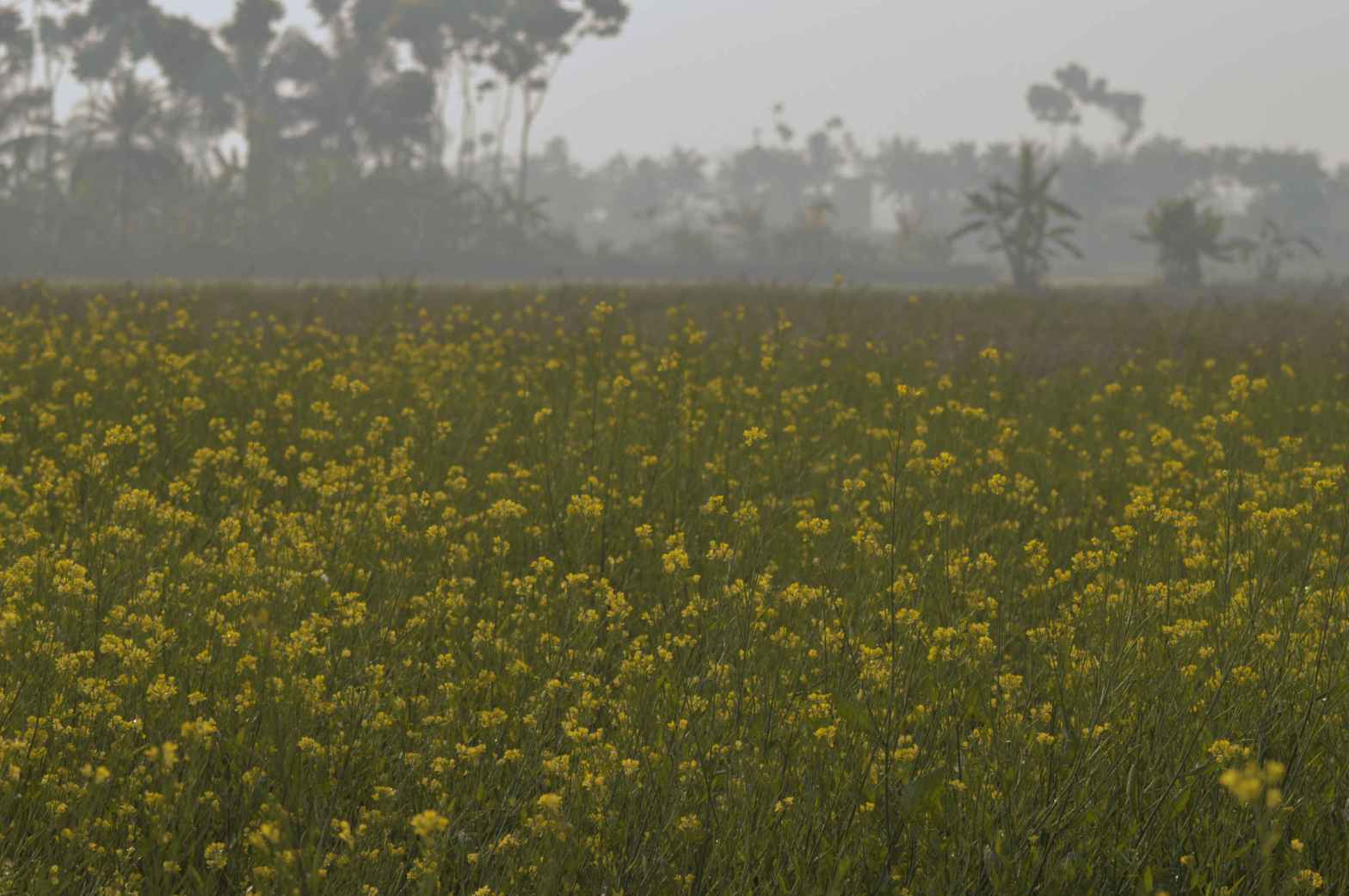
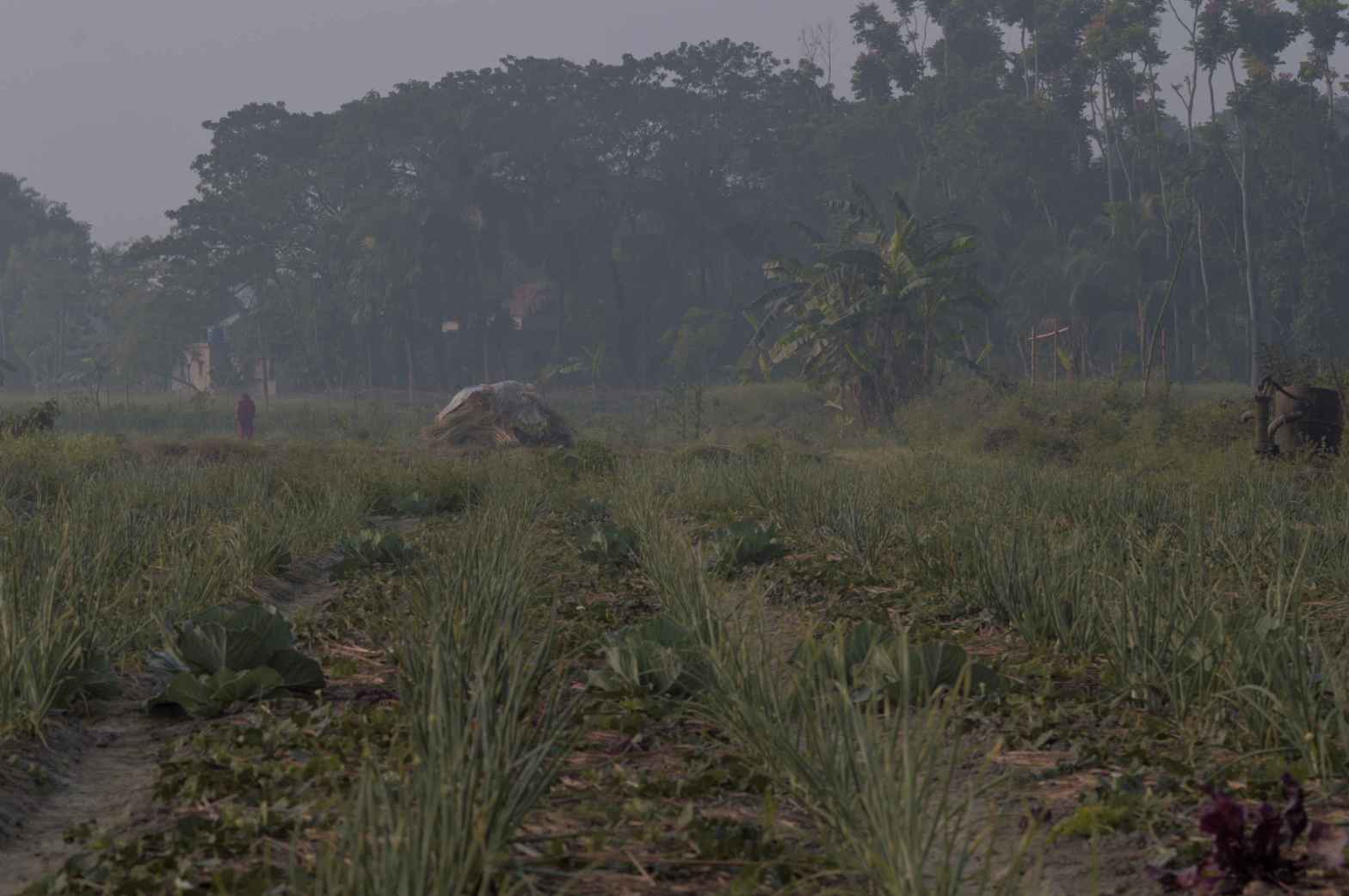
As far as agriculture is concerned, the main vegetables grown are cabbages, cauliflowers, onions, garlic, chillies, brinjals, carrots, beetroot, pointed gourds, beans, and potatoes. There are large yellow fields where mustard is cultivated and this whole process of extracting the seeds from the flowers is done mainly by the women which is a beautiful watch. What is left after the extraction is used as fuel for cooking, or as fodder for the cows. It looks very beautiful, just like the handmade artificial flowers and can be used to decorate houses. We collected some of them for our homes, which has intrigued many visitors.

The villagers don’t own much agricultural land themselves and instead, have to take them on lease. The profit from the produce, however, gets used up to pay this amount, leaving little for anything else. Even though most of the fields had paddy or mustard, it was relieving to see fields bearing seasonal vegetables like pointed gourd being produced on patches in between. This is the first time we got to know how much effort it takes to cultivate pointed gourd, especially artificially pollinating the crops using one patch of male flowers and pollinating the female flowers using the stamens of those. This work is primarily done by women, adding to their burden of responsibilities.

Unlike other villages, the farmers acknowledged the fact that they used harmful chemicals to cultivate their crops, which is quite unexpected and against the norm. They even used pesticides to kill earthworms, which ruin the beans. Because of so high pesticide usage, the farmers often fall sick while returning from the fields and even contract chronic digestive disorders.

They showed interest in learning natural farming, without the use of pesticides, and wished to switchover, if the yields were to match. Thus, if we host workshops there, we’ll certainly get people attending them, due to this high interest for it, they being aware of their impacts on them and others, with their knowledge of natural farming being limited to commercial organic mono-cropping practised before the green revolution.

The farmers have to sell their crops far below market price, which is equivalent to selling nothing. Such events are further enhanced through practices of strong arm middlemen, dictating who can sell their wares and where. We heard stories of farmers who took their goods to Sealdah being harassed and sent back.

The village has an interesting demography of consisting almost entirely of single mothers. Child marriage is very prominent in the village with girls being married off at around 12-14 years’ age. On bearing children, most of these girls have to face divorce from their husbands and have no choice but to return home. Thus, in several families, there is a de facto matrilineality present, consisting of single mothers: grandmothers, aunts, mothers and daughters. The relationship between such single or rather, singled mothers and their children is very beautiful and unique, forming deeper bonds, as they lack a father. Many of the women take their children to their workplaces, the fields, where they play while observing their mothers work.

Lacking the privilege of education due to this societal pressure of early marriage, many in the village aspire for women’s education. They wish their children to get well-educated and find decent jobs in the urban spaces, leaving the rural environment behind. This dream however took a massive hit from the Covid-19 pandemic and ensuing lockdown, which took the school away from the children, especially in a village lacking smartphones or computers, and further, lacking electricity for extended periods of time after Amphan struck. This has also led to an increase in the number of dropouts and, even in child marriages among women, who for the poverty-stricken families is often an extra mouth to feed. The rampancy of child-marriage is also a result of the prevailing ageist beauty standards, which make it difficult for older women to find partners, as well as the dowry system, which is why, families marry off their daughter as soon as they find a groom asking for a low dowry, as one would sell falling shares in a stock exchange.

Nevertheless, few women want to brave the market and become entrepreneurs, staying in the village and selling products they can make from the rural space. Their skills mostly include stitching, cooking, making food products, such as pickles, chutneys, etc. We were given a delicious taste of their skills through some bread rolls, jaggery and shoru chakli, beef stew, and a delicious daal with eggs and vegetables thrown in.

This begs one to state how well we were treated by the villagers, who went out their way massively, to look after us, some delicately juggling their jobs, and “domestic duties” for this purpose. At the same time however, in this web of mutuality, what struck us were the strong economic disparities between the members of the extended families, and even neighbours. In the village, only owners of cows could avail the luxury of a dung kebab, the rest being forced to use sticks and crop leftovers they find. This was even true among families, where siblings or cousins living next to each other would not share it, and cook separately — one under the open sky, the other inside a roofed hut or even a brick & concrete building.

A village of infinite possibilities but lacking guidance and confidence to make use of the extremely hardworking dedicated people as well as enriching resources. The lack of knowledge of the outside world or the lack of community building capacity are the hindrances. They need to be made more aware of the activities happening around the world for that would give them the scope to think outside the box. It has to them who comes up with a idea as they know their land and people more than us. What we can do is hold workshops and screening sessions where they get exposed to various films and documentaries of women and community works so that they know about the possibilities. Also, we have to work and constantly engage in conversations with the children in the village so that the different social issues can be stopped, so that they raise questions when something is wrong. We can also arrange for an awareness campaign for the farmers to let them know the alternative ways of agriculture/natural farming as they seemed interested in knowing and learning whether it is possible to practice farming without pesticides. Or to create a farmer’s market over there with few families who own lands so that they earn more than they are earning presently and the rest can follow. They can also think of using the waste products like jute and the crop residue of mustard plants after harvest for making decorating stuffs and selling them in the city as almost all the households have that in abundance. And it’s absolutely free. What I felt was as there were too many animals, there might be some possibilities of using those animals for some purpose. Need to think about that though.

Penned by Sanghamitra Mukherjee.

Session on Women’s Rights and Muslim Personal Law

Jaladarsha Collective initiated a session on Women’s Rights and Muslim Personal Law conducted by Sabir Ahmed at Swarupdah Gram Panchayat on 1st February 2021. We discovered a village composed largely, if not almost entirely, of economically backward women who had been married off around 12-14 years, and then, divorced or widowed, mostly after they bore children. Mostly farm labourers, they wished to move out of the village to work elsewhere, especially as caregivers, which many of them did before the lockdown. Formally educated mostly till class 10, with class 5 or lower being the norm, they very much wish their children to get properly educated and find jobs outside, a difficult task due to them losing interest and dropping out, or struggling with tuition fees from private tutors, the government school education being below standard.

On our way back, to our friend’s house where we were accommodated, we passed a mechanized stitching shop, where we learnt, men stitch shirts and blouses at 13 a piece. The yard that greeted us was already preoccupied by ducks, fowl, and goats. Rearing these animals to a healthy adulthood, having them give birth to young, and selling them at higher prices constitutes an important source of the family incomes. The room given to us, a concrete house in construction, belonged to our friend’s uncle. This is a common trend in the village currently, of new, concrete houses being constructed, as part of Pradhan Mantri Vikash Yojana, the trend possibly having increased more post the destruction of Amphan. Ours incidentally retained its earthen base and floors, while also sporting modern LED lamps, like many other similar buildings in the village. As part of this exercise and to strengthen the fields, we found mud being excavated in the village and carried elsewhere in tractors as well.

We passed several such sites on our way to the banks of River Sonai, which also serves as the border between India & Bangladesh. This part of the border is said to be relatively peaceful, with gunfire often being exchanged in other parts, downstream and up. The banks boasted of a BSF outpost and few boats, only one being in use though. This was a spot where villagers freely bathed in and did so even in that hour of twilight. However, a mistaken sight and a comment from the young woman who guided us, made us realize how strong the supernatural and superstitious played in their lives — expecting demons, ghosts and other kinds, as naturally as one may observe birds.

The ghats also bore several mango trees. However, unlike those on the residential grounds, whose berries (কুল) neighbours could munch on (as were we), these trees were owned by the soldiers, who rented out the buds, earning from the fruits thus. There were boys playing cricket underneath. On our way back, we found another group of children, much within the village, much younger and without any gender separation, playing a game similar to tag. We also witnessed one woman feeding clams and snails to her geese, that she’ collected from the pond earlier in the day. This was incidentally her maternal place, where she’d also come to use the see-saw for husking and grinding. A peculiar site one could see around the village, was that of kebab style dried cow dung, which the villagers used as fuel for cooking.

On returning, we found ourselves greeted with evening tea and snacks, along with full rolls of biscuits, which would consistently come with every such meal. This we found quite strange, wondering if it was just the goodness of heart, confusion regarding consumption, or maybe just some blind hope of an urban boon. The sun having bade its daily farewell, the sky revealed to us a new delight — clear visibility of the stars and constellations, which would give any astronomer a turn on. A sight which the cold weather made us blind to, with a bonfire from the dry wood of the post-harvest leftovers. A little further, we found the woman we met earlier, now at her in-laws place, cooking for the night. She however, was using collected sticks and other wood, like what we used for the bonfires. We learnt later that those cow dung kebabs are only for those who owned cows, not those without. This wasn’t the only time that I felt property raised its ugly head. Her kitchen lacked a roof and wall, sitting next to her in-laws’, which was not only walled and roofed with a tall chimney, but also used the said cow dung kebabs and had extra stoves.

One thing that particularly amazed me was how well adapted the people were to this hard life, so far from our urban comfort, and so low on energy demand, as to manage with one light, no fridge, cook using collected wood, and bathe in the shivering cold of the night in cold water.

At night, a misinformed rumour came by us, about the power supply being switched off for the coming two days, due to a transformer installation in nearby Dakbunglow. We learnt that in case of such events or even minor repairs, the electricity supply stays off for consistent periods of time in the village, even 20 days at a stretch. Recently such events have reduced, but previously, this was coupled with the power being switched off for about an hour every night daily, illegally, to smuggle goods in the dark. Thus, the electric supply to the village is quite unstable, calling for localized renewable sources. Thankfully, this did not occur during our stay.

During this first day and night, we couldn’t help but compare it with our urban lives. The only toilet for 3-4 houses here was limited to one with only hand-pumped deep tube wells to provide the water. Needless to mention that this was outside the house and eerily, without any lights affixed, needing people to carry their own ones. The village in fact, really lacked lights for illuminating the exterior spaces. This I’d say is a precursor to any activity that’d require people to meet after sunset, the part of the day currently free from the socio-economic pressures of the village. Strangely, the toilet was quite clean despite the pressure put upon it. The arrangement was mostly similar throughout the village.

The following morning we went out to survey women, with the help of the vaccination supervisor for the village, who we’d incidentally met, feeding the ducks and cooking at night. We interviewed several women, who mostly owned no land, worked as farm labourers, and reared cattle. They’d little education or particular skill-sets, beyond cooking and domestic activities. Mostly married around 12-14, they’re today struggling to educate their children, with only NGO & government schemes or kits aiding them. Failing, most have chosen to marry their daughters off at minor ages — just to escape poverty.

Most women and men in the village do not own land, but are forced to take it on lease or on loan. This is a particularly important reason for not developing any regenerative attitude, the land being someone else’s in the future. The lease price is generally ₹10,000 for 8 katahs. Following our interviews, we travelled to the border check post, to check the crops there. We found significantly greener pastures, with intercropping practised — little gourd (পটল) being the primary crop, mixed with onions, cabbages, cauliflower and corn on the periphery. There were also mustard and rice fields, and few date palms, all being tapped for jaggery. The palms were too few, but we learnt that farmers find it difficult to plat tress due to neighbouring farmers complaining against their shades. In this area, irrigated by not-at-all-salty river water, the farming method is extremely mechanized and petrochemical industry intensive. A farmer we interviewed too agreed, and said they’re bound to the practice despite its nutritional drawbacks, due to higher yields compared to traditional mono-cropping with organic manures. He even agreed to have applied insecticides against earthworms which ruined the little gourds, which he knew was insane. This was sad and shocking, and we realized that strong examples of modern, permaculture approaches have to be spread to remove such misconceptions.

It must be mentioned here that the purity of the river water is in strong contrast to the salinity of the groundwater here. Factoring in groundwater recharge issues, one wonders if rainwater harvesting or solar desalination, for which enough heat could be obtained during the day, could be some alternatives, if the river water is not obtainable for domestic use due to legal reasons. One fascinating thing was that the slightly warmer water evaporating visibly in the cold weather and there being a distinct but mild H₂S smell coming out. It is uncertain, if this is due to bacterial action or some deep-seated geothermal source.

Time soon found us in a follow-up session with the women, where more tragic stories of domestic violence and abuse cropped up — from the ‘usual’ getting divorced after childbirth, to having kerosene poured into one’s eyes in anger. In organizing this event, there was some noted confusion and lack of coordination, which could be attributed to the circumstances. When asked about future plans and desires, however, we found a general wish of leaving as care workers abroad. Further discussions about working from the village, created a choice between manufacturing food items to stitching. Most strangely desired to stitch, despite even the most enthusiastic people admittedly lacking necessary skills. One woman, who earlier used to work in Mumbai at 14,000 a month, showed a strong proficiency and knowledge in making food products, especially pickles, whose recipes she picked up elsewhere and could teach others. We got a literal taste of her skills the next morning through some delicious bread rolls, too. I still wonder why the others consistently chose stitching, despite discussing sweet recipes — due to the desire to revive some old sewing machines at home they had or maybe due to some influence of the garment workshop in the village. But of course, this would need some thought, as the village lacked lights, which would be a necessity for the task, the women being free mostly after twilight. Whatever the decision though, the women do require strong training to help grow these dreams, be it in food packaging and laws or even stitching. I believe if they could come together one hour every week, as they had for our meet, a lot of possibilities would emerge, such sessions serving greatly to sharing their existing skills alongside learning new ones.

A thing to mention, we found in our walks earlier, some curious new products from other parts of India and our state, uncommon in Kolkata; “phuchka chips”, being one particular, which some of them too got intrigued by.

Concluding the day with a visit to the nearest bus stand, we realized how far villagers had to travel for even the most basic stationery items, it being a long auto rickshaw ride away. This part was quite urban and even hosted a fair, which for a friend of ours was a first time experience. It goes to say a lot regarding the lack of freedom in the lives of women, whether due to work loads or outright control. Interactions with some grown men the next day would give us a taste of the same through a barrage of casual questions about personal choices and breaking norms, with many associating certain casual deeds like sleeping on a tree to the male sex alone.

During the evening, we found a second instance of property politics, when we had to be shifted from our friend’s uncle’s house to her brother’s despite him not being an inhabitant for long. This moment also brought up our friend’s fear of ghosts at night, which if one generalizes to the village, makes movement difficult beyond dusk.

The date-palm sap for breakfast next morning was extremely refreshing a taste, to say the least. It is however, not transportable and quite difficult to obtain due to its lack of abundance. The morning sight of cattle made us realize the life women had.

Life in Daharkanda begins early in the morning, to call the roosters rather than to their call. So too begins the list women’s responsibilities. Set free the ducks, chickens and goats, but not too much, lest they stroll into the fields, off the yards. Prepare the feed, some specially, others, using leftovers of the day gone by. Duty call! Jobs like vaccination rounds or into the fields as labourers for the farms. Prepare the food, with wood or dung kebabs for their earthen stoves. The children need looking after, the husbands toiling in fields or them being divorced or widowed, single mothers — bathing, clothing and making them food. Looking after their education, official and via tuition. Serve lunch, eat, do the dishes, create more feed.

Thus, the day passes, with few fleeting moments to spare for a meet or anything else.
As the sun begins to set, time knocks to herd the cattle back into their cages. Scatter some feed, call them back, out loud. The next day’s preparation begins now. On the see-saw husking and grinding, or maybe into the pond, collecting clams and snails. Finally, it’s time to warm up dinner. As night falls, one has to return home, since that’s the rule. Time to do the dishes one last time. Off to sleep now, for the day to repeat the day gone by.

The cattle, a central part of their lives, with most preferring small ones like goats and fowl to cows, it is strange that no food processing work has emerged in the village, such as goat milk cheese or egg related items like pastry cream or mayonnaise, mustard being so strongly present as a crop in the village. Our visit to the adjacent fields that morning and to nearby houses in the afternoon, gave us a glimpse of the same, from harvesting to threshing. Even the leftover crops, usually burned, does seem quite usable as a unique decoration item for urban homes.

The fields, themselves, that were left after the harvest, had signs of unintentional mulching. Nevertheless, the fate of most of it would be to in the jaws of tractors, upturned and mixed with fertilizers, despite there being signs of nitrogen fixing plants in the lifeless heaths. This takes quite a long wait too, as lacking roads, they can’t be brought in through other fields, until all has been harvested, everywhere. The paddy fields boasted of algae, probably from eutrophication or probably intentional. It did, sadly, lack fish whose wastes are documented to have improved the process. The fields also had several coconut trees, whose fruits were plucked ripe and exported. Coconut oil making too is a dying art it seems. So too is possibly clay making, there being many sun dried mud stoves with chimneys in the making, but all dependent on mud from the river banks.

On the final evening, we decided to have a picnic, when the women would be free. This exercise was quite interesting and insightful. As all had to be bought from the market, the budget came to 50 per head. This, however, was not an easy feat like one would imagine and there was a lot of observable negotiations happening to achieve this. Following this collection, however, the shopping was done by the women, quite smoothly. At night everyone coordinated well and started with the cooking, sharing equipment, both their daily equipment and hacked agricultural equipment for illumination. The tasks for cooking did however, seem to fall on few shoulders. Sadly, as time swept on, into the night, the picnic got limited to only the warm-up song and recital sessions. Most dispersed with the food, saying it was too late, and they’d not be allowed by their families to stay longer.

The next day, after a few final visits and tours, and tasting a delicacy from the previous night’s labour, we bade farewell.

Penned by Arkoprovo Ghosh.
Design a site like this with WordPress.com
Get started